HEADLINE NEWS
Google to Expand Wallet to Europe in 2012; Sees One Wallet Per Phone

LONDON – Google plans to launch its Google Wallet in at least one major European city during the first half of 2012, said Osama Bedier, Google’s vice president of payments, who discounted talk of a coming NFC wallet war in either the United States or Europe.
Bedier, who spoke today at the NFC Payments Europe 2011 conference in London, contends the Google Wallet will be open, adding that the search giant has received a welcoming response among service providers and other prospective participants in Europe, even from mobile operators, he told NFC Times in an interview.
“We found that European partners were willing to move faster (than in the United States),” he said. “There is a better understanding of the whole space. The ecosystem is more collaborative than in the States.”

But as in the United States, some major mobile operators in Europe are planning their own wallets and are unlikely to want to see their brands take a backseat to Google’s, even if Google agrees to put its wallet on the SIM cards that the telcos issue.
“I doubt that it would be acceptable for the operators in Europe,” Jörg Heuer, who leads the research and development team developing an NFC mobile-wallet program for Germany’s Deutsche Telekom Group, told NFC Times. “For my company, that would create a connection between two brands on a level that is just not what we would like to see.”
Bedier did not say which banks, processors, card networks or mobile operators in Europe that Google has been trying to recruit for its wallet. He said the talks began around the same time as those with U.S. companies.
Google unveiled its wallet in the United States last month with partners Citigroup, MasterCard Worldwide, mobile carrier Sprint and merchant acquirer and trusted service manager First Data, along with nearly 20 major retail chains, including Subway sandwich shops, Walgreens retail pharmacies, the Toys “R” Us toy store chain and Macy’s Department stores. Google is believed to have subsidized part of the cost of contactless point-of-sale terminals for the merchants.
The search giant plans to make money by charging merchants and other advertisers to deliver targeted offers, including coupons, to consumers, while not charging any fees to banks or other payment service providers it allows into its wallet.
“We started by pulling together a partnership with some of the biggest brands in the U.S.,” he said in response to a question during his presentation today. “And we intend to do that in almost every geography. And if it wasn’t clear from my presentation, our plans are to expand globally.”
One Wallet Per Phone?
Bedier, in responding to a question from NFC Times, suggested that any given NFC phone would have only one mobile wallet, and if that wallet is Google's, the company would need to either control the secure chip that holds the wallet applications or be able to manage those applications.
That means a Google Wallet is unlikely to share space on the same phone with, say, a wallet from the Isis mobile operator joint venture or one from card network Visa Inc.
Isis is a joint venture of AT&T, Verizon Wireless and T-Mobile USA and like Google is planning its own mobile wallet, which would enable payment, mobile offers, ticketing and other applications. Visa plans a digital wallet that consumers could load to their various devices for both online and NFC-based purchases.
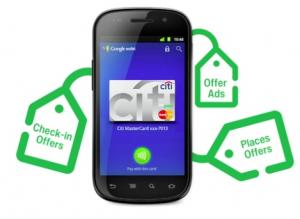
Google controls the secure embedded chip in its Nexus S 4G phone, which is the first NFC handset that will get the Google Wallet when the service launches–planned for this summer in New York, San Francisco and a few other cities, which are expected to be Los Angeles, Chicago and Washington, D.C.
“In terms of other wallets, there can be only one wallet at any one time,” Bedier said in response to a question from NFC Times. “Now we’re open to other wallets existing at other points of time. We’re open to consumers choosing whether it’s our wallet or someone else’s wallet.”
That sets up the prospects for a wallet war if such other wallet providers as Isis do not back down and accept Google’s wallet on Android phones they sell to subscribers.
“There’s got to be (a wallet war),” said Nick Holland, senior analyst for the Yankee Group. “Google and Isis are directly conflicting.”
Google in Control
But while it pledges an open-wallet platform, allowing various payment, loyalty and other service providers, Google clearly sees itself as the one to control the wallet itself.
Bedier insists Google is in the best position to pull together the merchants and other m-commerce players to deliver a compelling wallet, “as opposed to 10 mediocre wallets” that might spring up to vie for the attention of consumers.
“What we’re trying to accomplish with the open wallet platform, instead of everyone creating their own wallet, they would join on this open (Google) wallet platform,” he told NFC Times, adding: “We're good at software.”
While Google Offers and related personalized mobile promotions underpin Google’s business case for its wallet and mobile-commerce initiative, Bedier said Google would allow other service providers to deliver offers through its wallet at no extra charge.
“It doesn’t make sense from a consumer’s perspective to say your Google Wallet can only have Google Offers,” he said. “We want to have other offers. Consumer choice is a really an important principal to our design and philosophy of our wallet.”
Google Wallet on the SIM
Bedier confirmed that Google would have to either control the secure chip that holds the applications in its wallet or be able to manage the applications on the chip. That is especially important for the payment applications, but Google also will store the coupons and other offers on the chip that it plans to enable consumers to redeem with a single tap of their NFC phones.
The wallet could go onto SIM cards, in addition to embedded chips. Mobile operators issue SIMs and so ultimately control the encryption keys that can unlock access to the secure element on the SIM. Bedier said Google knows it will eventually have support a SIM-based secure element for its wallet, since some telcos will insist upon it.
In addition, unless it delivers another NFC handset of its own, like the Nexus S, Google would not have direct control of embedded chips in other Android NFC phones or non-Android NFC phones that might eventually support the wallet.
But Bedier said it was not necessary for Google to own the chip itself. “We’ll work with whoever owns that secure element to make sure we can manage it, Bedier said. “I think ownership and management are two different things.”
It’s likely there will be multiple secure elements in many NFC phones, especially embedded chips and SIM cards. Bedier said it’s possible to have a different wallet on each chip, though he acknowledged that both secure chips could not be active at any given time to work with point-of-sale terminals, under current standards.
Discount on Scones
Bedier during his presentation reiterated that Google has placed a “big bet” on NFC.
The company sees an opportunity to greatly expand upon its successful Web advertising model by using NFC phones to make the connection between the online and offline worlds.
For example, users could tap their phones to check in upon entering a store and receive offers that they could immediately download to their phones and place in their wallets. Or they might find promotions during mobile Web searches or be sent the offers directly to their mobile inboxes, similar to the Groupon deal-of-the-day model on the Web.
The consumer could get personalized offers, if he opts in, said Bedier. For example, after entering the store and tapping a smart poster, the retailer might know he likes scones and could send a message to the shopper’s handset saying there are fresh scones in the bakery and offer a discount.
Bedier quoted projections putting NFC phone numbers at between 750 million to a billion handsets in five years.
By then, NFC tags could be cheap enough to replace bar codes on product packages. “Consumers should be able to go around to those products while they’re on the shelf and tap them to buy them,” he said, adding that smartphones could eventually replace point-of-sale terminals.
“I can’t imagine 10 years from now the point of sale looks the way it does today. The consumer not only holds the wallet in their hands, but they’ll also hold a variation of a terminal in their hands.”