HEADLINE NEWS
Isis Announces Terminal Vendors as It Seeks to Spotlight M-Commerce Applications

The Isis mobile operator joint venture has announced that four major point-of-sale terminal and contactless reader vendors have licensed its mobile-commerce application, as the venture gears up for its soft launch in two cities this summer.
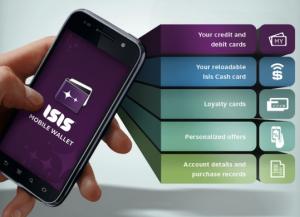
With the announcement, Isis seeks to put the spotlight on such features as offers, rewards and coupons that its platform will support, following last week’s announcement of its first three payment issuers, JPMorgan Chase, Capital One and Barclaycard US.
While the vendors, VeriFone, Ingenico, Vivotech and Equinox, were already onboard for the Isis launch, just as they are supporting the Google Wallet, Isis hopes today’s announcement draws more attention to its plans to build a system for delivering and redeeming offers, loyalty and coupons, along with payment.

Isis’ chief technology officer Scott Mulloy told NFC Times that Isis is building an m-commerce platform that will give merchants flexibility in choosing what type of discounts, rewards and other incentives they offer from the wallet.
Consumers would be able to “clip” the coupons, rebates, vouchers and other promotions by browsing mobile Web sites or by tapping their NFC phones on smart posters and downloading them, and perhaps also by scanning 2-D bar codes in print advertisements. They could put these promotions into their Isis wallet.
And plans call for sending offers and other promotions to consumers who opt-in based on geolocation, preferences and buying habits.
“(This gives) the ability to the vast majority of retailers and merchants, which see a path to become commerce partners,” said Mulloy. “Whenever you’re introducing a new technology, you want to be better than existing offers.”
By existing offers, he was referring to paper coupons, loyalty cards on key fobs and cash.
The concept is similar to Google’s mobile-commerce platform for its Google Wallet, which is designed to enable users to pay and redeem coupons, offers and rewards with a single tap of their wallet phones.
Isis calls its m-commerce service “SmartTap,” and has trademarked the term, just as Google has trademarked “SingleTap.”
And like Google, Isis plans to charge fees from merchants when consumers redeem, say, a digital coupon or reward.
That’s in addition to plans by Isis to charge fees to payment issuers, such as banks, to put their applications onto SIMs or other secure elements in NFC phones sold by the joint venture partners, Verizon Wireless, AT&T and T-Mobile. Google is not charging payment issuers to be part of its wallet.
New Terminals Needed
But like Google, Isis is no doubt finding equipping merchants to accept payment and offers in one tap a challenge.
Six months after launching its wallet, Google still only promotes about a dozen retail chains as supporting SingleTap and only a limited number of locations of these merchants actually accept payments and promotions with one tap of the phone.
Both Isis and Google deem the one-tap concept as key to offering a compelling user experience. But this requires added investment by merchants or others providing point-of-sale terminals for the rollout.
Most of the hundreds of thousands of contactless point-of-sale terminals at 150,000 merchant locations in the United States that accept contactless payment cannot also accept coupons, offers and loyalty programs in a single tap without a hardware upgrade. UPDATE: Google, however, has said that it's technically possible to do SingleTap with the existing contactless terminals, if they have software upgrades. END UPDATE.
But for the technology to work as designed, the contactless terminals should have an NFC chip similar to the one in the phone the consumer is tapping, enabling two-way communication between the phone and terminal. Contactless-payment terminals that accept MasterCard PayPass, Visa payWave and other contactless-payment applications mostly have contactless chips that can only do one-way communication. So they only can read the account details from contactless cards and phones tapped on them.
The two-way communication is needed for Isis’ SmartTap and Google’s SingleTap because the POS terminal needs to identify itself and the merchant it represents to the phone, which then can redeem the proper offers, discounts or points, said Mulloy. The phone also sends the payment details as part of the same tap.
To make the transaction in a timely manner, both payment and promotions are stored on the secure element in the phones, which anchor both the Isis and Google wallets.
In today’s announcement, Isis said merchants can become “Isis-enabled” by installing new terminals with "NFC add-ons," which apparently refers to readers. Or they can do remote software upgrades. The latter option would be available for POS terminals and readers that already pack NFC chips, which vendors have been incorporating in their products of late.
The m-commerce software on the terminals ties into Isis m-commerce servers.
Of course, merchants could decide to only accept contactless payment from the wallet. And if they don’t already have contactless terminals, they might wait until incentives by Visa Inc. and MasterCard Worldwide kick in over the next few years for upgrading their terminals to accept EMV, as well as contactless payment.
That would not help Isis gear up, especially for the large pilots planned later this year in Salt Lake City, Utah, and Austin, Texas. It’s not clear who will pay for the new merchant terminals or terminal upgrades in the cities. Isis chose Salt Lake City and Austin, in part, because it would be easier to have broad coverage of merchant locations in two mid-tier cities.
Isis CEO Michael Abbott has told NFC Times that partners in the project would pay for the terminals, but he declined to elaborate.
U.S.-based VeriFone, which owns the largest share of the U.S. POS terminal market, said in a separate press release today that its “sales, marketing and implementation teams will collaborate” with their counterparts inside Isis to target large retailers, as well as convenience stores in the two cities.
A VeriFone spokesman noted that the vendor’s terminals are used by 70% of the top 200 retailers in the U.S., and it also has a large distribution channel to small merchants through independent sales organizations.
“So there are many potential areas of collaboration with Isis,” the spokesman told NFC Times. “We'll be revealing more as Isis begins to publicize results of the pilots.