HEADLINE NEWS
Austrian Bank Announces Plans to Launch Mobile-Payment Service with microSDs and iPhone

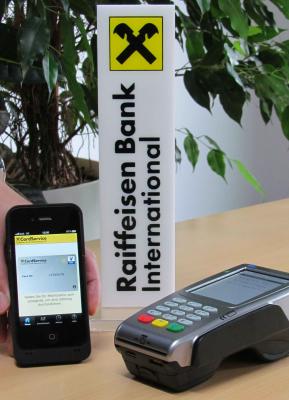
Raiffeisen Bank International, one of Austria’s largest banks, is planning to launch contactless-mobile payment with microSD cards and an iPhone attachment.
Raiffeisen Bank International, or RBI, said it would launch its “CardMobile” payment service with a Visa payWave debit application stored on microSDs in a major Austrian city in the second quarter.
The bank called the launch a “rollout,” but it’s unclear if it would put the iPhone attachment on sale generally to customers. Also, there are few contactless terminals supporting payWave or other contactless applications in Austria, at present.
Update: A Visa Europe spokeswoman for Austria said there are no Visa payWave terminals at present, and there would be a couple of thousand by the end of 2012. Gerald Kubu, head of card service at RBI, told NFC Times in a statement that all major acquirers in Austria plan to implement payWave acceptance in 2012. End update.
The service will use a contactless iPhone sleeve, called iCaisse, along with microSD cards from U.S.-based DeviceFidelity. If the CardMobile service is, in fact, more than a trial, it would be the first such project announced so far using DeviceFidelity’s In2Pay products, which have been trialed in the United States and elsewhere. Most recently, Germany’s Landesbank Berlin announced plans for an employee trial with the iPhone 4 sleeve and microSDs.
“We have decided to use the iPhone-platform for the initial launch of CardMobile,” said Gerald Kubu, head of card service at RBI, in a statement. “The support for other smartphones will follow.”
RBI, which has operations in 17 Central and Eastern European countries, will also begin to issue contactless cards in Austria. Update: But the bank is not releasing card figures. Also, it has not decided whether it will expand contactless-mobile payment outside of Austria. End update.
A partner on the project, Netherlands-based Cardis Enterprises International, said it has technology that provides banks, payment networks and processors a software plug-in for existing payment products and infrastructure to “reduce processing costs significantly.” The technology is targeted at low-value payments and saves on costs by aggregating transactions, Cardis told NFC Times.
Update: With the iPhone sleeve and microSD cards, along with the CardMobile app, Raiffeisen customers would be able to make payments of €20 (US$26.43) without entering a pass code. They could make higher-value payments with their pass codes, by entering them on the iPhone keypad, and tapping the phone again.
The service supports Visa’s V Pay debit service, but acts like a prepaid card. For purchases below €20, if the mobile wallet balance in the microSD chip is insufficient to pay for the purchase, customers will be prompted to enter their pass codes to load €50 from their bank accounts to the wallet and then to hold the phone to the payment terminal again to complete the load and the purchase in one transaction, Cardis told NFC Times. End update.
While users probably would be able to use Visa payWave terminals outside of Austria, it might be limited to €20, with no option for high-value purchases.
Update: The contactless-mobile service would likely compete with an expected NFC-payment service from Austria’s largest operator, Telekom Austria Group, formerly known as mobilkom. The telco plans to offer payment and other NFC services based on SIM cards it will issue, though has not yet announced launch plans.
Telekom Austria contends that customers could expect little backup support for contactless-mobile services like the one Raiffeisen Bank plans to launch.
“MNOs (mobile network operators) cannot even support the users in case of troubles and cannot block the service in case of theft or loss,” a Telekom Austria spokeswoman told NFC Times. “On the contrary, SIM-based NFC services provide maximum usability and security, hence we are convinced that SIM-based NFC payment services will be the most attractive way of providing NFC payment.” End update.