HEADLINE NEWS

OTI to Supply Contactless and NFC Readers for Gasoline Stations in North America

Israel-based contactless and NFC vendor On Track Innovations announced Monday it had received an order for 30,000 readers for point-of-sale terminals at retail gasoline stations in North America.

Taxis in Major U.S. Cities to Get NFC-Enabled Video Ads

Riders in 5,000 taxicabs in the U.S. would be able to tap on NFC tags on video advertising screens to download apps, brand information, coupons, maps, music and videos, according to technology suppliers that have equipped the taxis for potential advertising campaigns.

Analyst: Banks Have More to Fear from Cloud-Based Technologies Than NFC

Banks have much more to fear from cloud-based mobile payment than from NFC, even if mobile operators control the secure elements that hold the banks’ payment applications.

GSMA Proposes Global Standard for NFC-Enabled Loyalty and Couponing–Using SIM Cards

May 10 2013 (All day)

The GSMA mobile operator trade group is proposing a global standard for how point-of-sale terminals talk to NFC-enabled mobile wallets to enable consumers to redeem coupons and rewards.

Taiwanese Bank Gets Approval for NFC-Enabled Credit Cards; Okay for Other Banks Expected

Taiwanese banking regulators, as expected, have approved the first bank to issue mobile credit cards that could be downloaded over the air to SIM cards.

UK Retailer Marks & Spencer Sees Growing Use of Contactless

Marks & Spencer, one of the UK’s largest retailers, announced today it had rolled out contactless payment to 644 of its UK stores and said 14% of its card transactions under £20 (US$30.97) are contactless.

Identive Reports Growing NFC Business; Blames Flat Sales, Losses, on U.S. Budget Cuts

U.S.-based Identive Group reported growing NFC and smart card reader business, but fell back into the red during for the first quarter, a loss it largely blamed on U.S. federal government budget cuts.

German Bank and Telco Hold Small NFC Trial; Larger Launches Planned in Country This Year

As Germany gears up for NFC, German bank Dortmunder Volksbank along with Telefónica (O2) Germany have launched a small pilot putting a credit application onto SIM cards in Western Germany.

Cashless Technology Company Announces Rollout of Isis SmartTap on Vending Machines

Vending technology company USA Technologies plans to integrate the SmartTap mobile-commerce software into all of the company’s nearly 100,000 NFC-enabled terminals on vending machines nationwide.

Vendor Group: NFC Secure Element Market to Grow by Two-Thirds This Year

Smart card vendor association Eurosmart has substantially increased its estimate for NFC secure element shipments for 2012–by 50% to 150 million units–and forecasts that secure element shipments will grow by another 67% in 2013 to 250 million units.

Gemalto Reveals Some Details of MCX Deal; Vendor Will Earn Fees for Transactions

France-based smart card and security vendor Gemalto will operate the mobile-payment platform for U.S. merchant group MCX, earning a fee for every transaction, in addition to what appears to be a hosting fee it says is worth tens of millions.

Inside Reports NFC Revenue Down Sharply in First Quarter; Some Recovery Expected in Q2

France-based chip supplier Inside Secure today reported a sharp decline in its revenue in the first quarter from its NFC chips, blaming the situation on excess inventories of NFC chips on hand by its main customer BlackBerry.

Checking Labels: The Wine Authentication App that Also Promotes the Brand

By: 
Kiona Smith-Strickland

NFC technology companies have promoted the idea of using NFC tags to foil counterfeiters of luxury goods for some time.

Now more companies are proposing to combine the antipiracy technology with brand-marketing messages.

The latest is U.S.-based app developer ClikGenie, working with a tag supplier and printer, which have produced an app that authenticates wine labels while also enabling vineyards and other wine brand promoters to send consumers more information via a tap of their NFC phones.

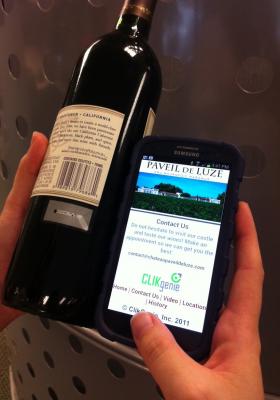
ClikGenie along with NFC tag supplier Smartrac and chip encoder and label printer FineLine Technologies recently released CLIKSecure, an NFC product authentication app that the companies say combines tag-based product authentication with merchandising. The app adds an anticounterfeiting feature to ClikGenie’s lineup, which had focused mainly on mobile merchandising and promotion using 2-D bar codes.

The companies demonstrated the application for wine authentication at last month’s Global Secure Summit in Istanbul, Turkey. FineLine CEO George Hoffman told NFC Times that CLIKSecure’s partners are working with customers in the luxury apparel and wine industries, though he declined to name any clients, he said, for fear of alerting counterfeiters.

“We think any high-end product that attracts counterfeiters is a viable market,” Hoffman told NFC Times, citing pharmaceuticals, tobacco products, and software as examples.

The NFC tags use a chip from NXP semiconductors. NXP, like rival NFC chip supplier Inside Secure, sees a market for using NFC to thwart product counterfeiters.

Last February, Inside introduced an upgrade to its anticounterfeiting chip technology. The new chip, which Inside calls VaultC160, includes memory space for both anticounterfeiting technology and product information. Consumers could tap to check an authentication certificate to confirm the originality of a luxury handbag, wine or watch while also downloading product pictures or recipes, according to Inside.

The CLIKSecure app backers chose fine wine for the recent demonstration because of growing counterfeit losses in the wine market. Premium wines can sell for a few hundred dollars a bottle, with especially prestigious vintages fetching prices in the thousands. 

European wine exporters are being hit especially hard by counterfeiters, with an expanding luxury goods market in China driving demand there for knockoff products, including wine. Chinese wine drinkers consume 100 million cases a year, twice as much as in 2005, according to French wine industry group Vinexpo.

Decades-Long Problem
Wine counterfeiting is not a new problem, however. The most basic method, printing a fake label with a subtly misspelled brand name or a slightly different logo in hopes of fooling buyers, is common to other luxury-goods markets prone to counterfeiting, including apparel and accessories. More ambitious counterfeiters might remove an authentic label and place it on a bottle with a similar shape, usually from the same vineyard, which contains a cheaper wine. Savvy buyers might identify the fake if the cork does not match the label. 

In an effort to combat these tactics, during the 1980s, some wineries turned to ultraviolet tags and microetched bottles to protect their brands, but high-end counterfeiters could get around these measures by recycling the tagged, etched bottles and refilling them with cheaper wine. Some counterfeiting operations even invest in special equipment to replace the original corks. Unlike the earlier ultraviolet tags, CLIKSecure’s tracking functionality could help catch recycled bottles before they reach consumers. 

The CLIKSecure app itself is available only to designated employees, such as product inspectors. When a CLIKSecure user taps the tag, the app reads the chip inlay’s UID number for verification. Each phone is assigned a unique serial number, which is also registered when the user taps a product.

“We record that unique phone as well as the GPS of the phone,” Hoffman told NFC Times. “This could be used to track products through the supply chain if the brand wanted to do that.” 

Product authentication requires the CLIKSecure app to run on an authorized phone, but shoppers tapping for product information can use any NFC-capable smartphone, without the app.

No ‘Random Google-Type’ Ads
After tapping the label, the tap will direct users to a microsite, which includes product information, along with messages from the vineyard or brand. This content might include targeted advertising. 

Interest is growing among advertisers in using NFC tags to both promote products and gather data on consumers to send more targeted advertising.

FineLine’s Hoffman indicated the wine label tags only send simple promotions, in the form of a URL, which is not customized to the user.

“We believe clients will only allow advertisements which add value to the site,” such as suggested cheese pairings for wine, rather than “random Google-type adverts,” Hoffman said.

Through the NFC tags and the microsites, brands also collect data about which products customers interact with and which pages on the microsite are most viewed, but not geographic or identifying information about individual shoppers.

Tags and Data Analytics
Netherlands-based Smartrac, which supplied the NFC inlays for the wine labels, has promoted use of tags for promotions through microsites and gathering data on consumers.

It also supplied the inlays for a high-profile print ad placed last spring by luxury car brand Lexus that enabled subscribers of Wired magazine to tap for additional information on the in-car navigation systems and apps. The NFC tags in the ad also collected data on consumers.

Smartrac, which did not respond with answers to several requests by NFC Times for additional information on the CLIKSecure project, told NFC Times in March following publication of the Lexus ad that tags could yield valuable data on the consumer for advertisers. Advertisers could get the times, dates and number of times the tag was tapped, for example.

The advertisers could then send more narrowly targeted follow-up promotions to those smartphone users demonstrating the most interest in the NFC-enabled ads, even if they do not know their names. Of course, even without the names, the tracking would require the consumers to opt in.

Though there are doubts that vineyards would want to put a QR code on their wine labels, which some consider unattractive, FineLine’s Hoffman recommends brands also use the codes in addition to the NFC tag, in order to reach the greatest number of customers.

“There are far more phones in the market that can read QR than can read NFC at this point in time,” he said. NT.