HEADLINE NEWS

OTI to Supply Contactless and NFC Readers for Gasoline Stations in North America

Israel-based contactless and NFC vendor On Track Innovations announced Monday it had received an order for 30,000 readers for point-of-sale terminals at retail gasoline stations in North America.

Taxis in Major U.S. Cities to Get NFC-Enabled Video Ads

Riders in 5,000 taxicabs in the U.S. would be able to tap on NFC tags on video advertising screens to download apps, brand information, coupons, maps, music and videos, according to technology suppliers that have equipped the taxis for potential advertising campaigns.

Analyst: Banks Have More to Fear from Cloud-Based Technologies Than NFC

Banks have much more to fear from cloud-based mobile payment than from NFC, even if mobile operators control the secure elements that hold the banks’ payment applications.

GSMA Proposes Global Standard for NFC-Enabled Loyalty and Couponing–Using SIM Cards

May 10 2013 (All day)

The GSMA mobile operator trade group is proposing a global standard for how point-of-sale terminals talk to NFC-enabled mobile wallets to enable consumers to redeem coupons and rewards.

Taiwanese Bank Gets Approval for NFC-Enabled Credit Cards; Okay for Other Banks Expected

Taiwanese banking regulators, as expected, have approved the first bank to issue mobile credit cards that could be downloaded over the air to SIM cards.

UK Retailer Marks & Spencer Sees Growing Use of Contactless

Marks & Spencer, one of the UK’s largest retailers, announced today it had rolled out contactless payment to 644 of its UK stores and said 14% of its card transactions under £20 (US$30.97) are contactless.

Identive Reports Growing NFC Business; Blames Flat Sales, Losses, on U.S. Budget Cuts

U.S.-based Identive Group reported growing NFC and smart card reader business, but fell back into the red during for the first quarter, a loss it largely blamed on U.S. federal government budget cuts.

German Bank and Telco Hold Small NFC Trial; Larger Launches Planned in Country This Year

As Germany gears up for NFC, German bank Dortmunder Volksbank along with Telefónica (O2) Germany have launched a small pilot putting a credit application onto SIM cards in Western Germany.

Cashless Technology Company Announces Rollout of Isis SmartTap on Vending Machines

Vending technology company USA Technologies plans to integrate the SmartTap mobile-commerce software into all of the company’s nearly 100,000 NFC-enabled terminals on vending machines nationwide.

Infineon Introduces New Embedded Secure Element, Hoping to Tap Growing Market

Germany-based Infineon Technologies today introduced a new embedded secure element, targeting the growing market for chips that handset makers are including in their NFC-enabled devices.

Vendor Group: NFC Secure Element Market to Grow by Two-Thirds This Year

Smart card vendor association Eurosmart has substantially increased its estimate for NFC secure element shipments for 2012–by 50% to 150 million units–and forecasts that secure element shipments will grow by another 67% in 2013 to 250 million units.

Gemalto Reveals Some Details of MCX Deal; Vendor Will Earn Fees for Transactions

France-based smart card and security vendor Gemalto will operate the mobile-payment platform for U.S. merchant group MCX, earning a fee for every transaction, in addition to what appears to be a hosting fee it says is worth tens of millions.

Visa and Samsung Agree to Enable Payment on NFC Embedded Chips; Deal Expected to Bypass Telcos

BARCELONA – Visa and Samsung Electronics have announced a landmark agreement that will see a Visa payWave application preloaded on the embedded secure elements in forthcoming NFC-enabled Samsung devices.

As part of the deal, Samsung will allow banks to load their payment account information over-the-air to the secure chips, using Visa’s mobile provisioning service. Visa announced the agreement today at the Mobile World Congress in Barcelona.

“The fact is, we believe this is a milestone for the industry,” said Jim McCarthy, global head of product for Visa, at a press conference today in Barcelona. “Just the relationship with Samsung alone, given that they’re the world’s largest smartphone manufacturer, will carry us a long way.”
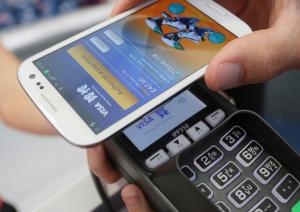
Samsung has been embedding secure elements in just about all of its Android NFC phones since the middle of last year and that is expected to continue.

So the agreement has the potential to enable banks and other issuers of Visa payWave applications to launch NFC payment on a range of new Samsung smartphones and without the involvement of mobile operators. 

Challenge to SIM-Based NFC
The deal poses a threat to the SIM-based model for NFC that mobile operators are backing–though in response to a question from NFC Times at a panel discussion on NFC today at the Mobile World Congress, Bill Gajda, Visa’s head of global mobile products, made it clear that the embedded chips with payWave onboard in Samsung NFC phones will likely not be activated in a number of markets. That would especially be true in those markets where mobile operators control the distribution channels of NFC phones.

“In terms of how and when that’s (embedded chip) going to be turned on, I’m going to be careful not to talk for Samsung; I think they are looking at markets that may not have heavily subsidized models (by operators) or the market is open to multiple secure elements,” he said.

Gajda said at the Visa press conference that a payWave application would be available on devices released by Samsung later this year. He declined to elaborate. The deal is nonexclusive with Visa, and Samsung could work with other card networks.

Those devices could include the much-anticipated Galaxy S4, expected to be released next month. Samsung has already shipped such popular models as the Galaxy S III and Galaxy Note II with an embedded chip inside, but has largely left them unused. Samsung’s Windows Phone 8 handsets will not carry an embedded chip, since Microsoft’s mobile platform does not support it.

As NFC Times reported last March, Samsung formed a mobile-commerce unit at its South Korea headquarters, headed by Victor Kim, former director of mobile payment for Visa’s Asia-Pacific region.

The purpose of the unit is to market the embedded chip and to develop other programs for delivering payment services in mobile devices. Among the likely markets for the embedded chip with the payWave application preloaded are certain countries in Asia and Eastern Europe, where mobile operators would not have the clout to force Samsung to effectively disable the embedded chip. They have largely done this with the Galaxy S III and Note II, among other devices, in the West. Samsung also might be able to get the embedded chip activated in phones sold by tier-2 telcos.

Kim attended the Visa press conference announcing the deal, but did not speak, and Samsung was not available for comment today. But Won-Pyo Hong, president and head of Samsung’s media solution center issued a statement as part of the Visa press release, saying “the partnership with Visa represents a step toward a global mobile-payment platform.” He added that Samsung and Visa believe that they “have a strong value proposition for financial institutions that will ultimately allow consumer choice in NFC payments.”

Lots of Embedded Chips
Chip makers have told NFC Times that at least two-thirds of NFC phones packed embedded chips in 2012 and that percentage is expected to remain about the same this year, during which more than 200 million NFC phones are expected to be shipped.

Such handset makers as HTC, LG Electronics and BlackBerry also ship phones with embedded chips. The phones also support SIM-based NFC applications.

Except for Google Wallet, mainly available on phones from No. 3 U.S. mobile operator Sprint, there have been few commercial uses for the embedded chips in Android phones.

HTC and LG have yet to reveal their strategies for their embedded chips. They, too, could do deals with payment networks, though they need to avoid a backlash from mobile operators much more than does Samsung, the No. 1 supplier of smartphones worldwide.

HTC last year introduced an embedded chip-based payment application in China with China Merchants Bank, supporting an application from China UnionPay.

BlackBerry, formerly known as Research In Motion, has said it will use its embedded chip for corporate badges and other enterprise applications, but appears to be steering clear of enabling payment, at least for now.

‘It’s Going to Vary, Market to Market’
Gajda confirmed to NFC Times that Asia and Eastern Europe are prospective markets for the embedded chip in the Samsung phones. But in response to a question at the press conference from a Canadian bank, he added that financial institutions in Canada might also get access to the embedded chips in the devices.

“I think it’s going to vary market to market,” he said. “Where banks can get access to those devices and that alternative secure element, you’re going to be able to create your own mobile wallet built on your own mobile-banking application that includes NFC payments, and we’re going to be able to use that Visa payWave applet that’s already on the device, out of the factory, as well as our provisioning service to get all of your accounts into those phones.”

Access to the device will depend on business discussions involving Samsung. And Visa did not reveal the business terms for its deal with Samsung or how the device maker would get paid for allowing access to its embedded chips.

The mobile provisioning service would download and manage Visa account information over the air to the embedded chips. France-based Oberthur Technologies will operate the service, using its TSM service. It will connect with the key management system for Samsung, which creates secure data storage domains for issuers on the embedded chips. Samsung SDS is managing that system for Samsung Mobile, NFC Times has learned.

Banks can use their own TSMs, as well, to provision the payWave application.

Gajda said he believes mobile operators in some cases might also use the embedded chip instead of the SIM cards to enable the Visa payWave application.

“Even for mobile network operators, whether it’s to address (memory) capacity issues of the SIM, or just because they don’t have to replace the SIMs now in order to facilitate NFC, I think we’re going to see a number of parties really look favorably on this alternative secure element because it broadens the options for banks, mobile network operators (and) device manufacturers to provision credentials on phones,” he said.

Industry observers say telcos would have to do separate deals with Samsung to gain control of the embedded chips in the Android phones they buy.

Telcos Likely to Look Askance
It remains to be seen whether telcos with SIM-centric NFC business plans go for an embedded secure element. And reaction from telcos to the deal is not expected to be positive.

Pierre Combelles, business lead for the NFC program at the mobile operator trade group GSMA, which organizes the Mobile World Congress, said the embedded Visa applet was an interesting development, but questions the upside for consumers.

“We’re back to the question of managing the service lifecycle, and we think this is what the mobile operators are good at,” he told NFC Times.

Telcos are selling their SIM-based NFC service as a way to offer consumers one point of contact in case of problems or if their phones are lost or stolen. That is a key advantage the SIM-centric model offers, said François Xavier Godron, head of NFC for the French market for France Telecom-Orange–a strong backer of SIM-based NFC. Telcos are renting space on their NFC SIMs and also using the SIM as a control point for mobile-commerce applications.

It’s easy to cancel the service on the SIM and to replace the service on a new SIM, Godron told NFC Times. “We can control it and send another SIM card,” he said.

When asked whether Orange would allow the Samsung embedded chips to be activated in phones Orange sells in France, Godron replied: “We’d have to think about that.”

Gajda said Visa and Oberthur would be able to manage the life cycle of the payWave applications “on behalf of Samsung or whoever controls the (embedded) secure element” in the phones.