HEADLINE NEWS
Apple NFC Patents Would Turn iPhones into Payment Devices

In a new NFC patent application for the iPhone, Apple for perhaps the first time casts the phone in the role of a contactless-payment device.
The patent request, published last week and filed last year, though just coming to light, would enable users to make peer-to-peer payments by tapping their iPhones together, using credit card, bank or iTunes account data stored securely in the phones. They could also tap the phones on other devices to make payments or transfer money, for example on desktop computers or even point-of-sales terminals, according to the patent application.
UPDATE: And other patent applications emerging this past week have described NFC-enabled iPhones acting as POS terminals, including scanning products and taking payment. And iPhones could also make ATM transactions and store credit card, debit card and other payment accounts according to user preferences, then make retail purchases, stated the patent requests. The NFC interface would be involved in these financial transactions, but it's not clear whether Apple is claiming the retail transactions would be conducted in card-emulation mode like most payment services being developed for NFC phones. None of the recently published Apple patent applications specifically mentions the iPhone working in card-emulation mode, that is, mimicking contactless cards, although the descriptions of the mobile retail transactions are similar to the way contactless cards transmit data to readers.
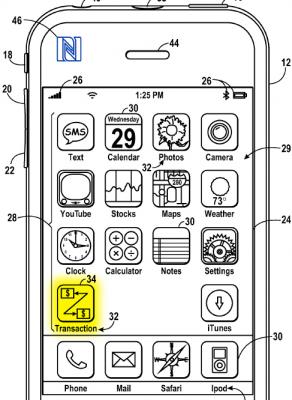
Exchanging P2P payments by tapping phones together and also by reading contactless and conventional cards is the vision, at least, depicted in one of Apple’s newest patent requests involving NFC, “Peer-to-Peer Financial Transaction Devices and Methods.” It follows disclosure of another iPhone NFC patent request that recently emerged, which gives Apple’s smartphone a central role enabling a range of devices–from iPods to televisions–to share video clips, TV shows, movies and other “resources,” including displays and audio features. Earlier patent requests had described the iPhone using NFC to sync data and send commands.
Anticipation is running high that Apple will incorporate NFC technology in one of its future iPhone versions. Its fourth-generation iPhone is expected out in June or July.
But before the most recently published patent requests, Apple had made little or no mention of how an NFC-enabled iPhone might be used for payment, which is the most talked about application among mobile operators and service providers considering rolling out NFC services. The new patent application includes an illustration with the example of an icon called “Transaction” on the iPhone home screen to initiate transactions (see illustration above).
The patent request, for example, describes how a group of friends could split up a restaurant bill by tapping their phones on the phone of their host after he had paid the cashier with a tap of his own phone. The host would have downloaded the dinner bill from the restaurant’s own NFC device, then divvied up the bill by touching on his screen various menu items his friends had ordered. Or each one of the friends could tap the cashier’s NFC device after she touches the menu items they had ordered.
An iPhone Secure-Storage Area
This particular, 244-page, patent request does not mention retail payments by name and spends little time discussing the possibility. Instead, it focuses on peer-to-peer payment, mentioning for perhaps the first time the idea of the iPhone sporting a “secure-storage area,” which might include an embedded smart card chip. The secure area could store encryption keys, digital certificates, PIN codes and bank or credit card account information, as well as information related to iTunes accounts.
And users could protect or lock the secure area with a PIN code.
“As can be appreciated, the security features described herein may aid to preventing the device (iPhone) from being used to make payments by unauthorized persons,” states the patent application.
But it remains to be seen whether banks and payment card networks, such as Visa Inc. and MasterCard Worldwide, would go along with the security of Apple’s vision for payments using their cards or accounts, at least as described in the patent application.
The document describes iPhones going online over WiFi networks to seek authorization from “financial servers” for P2P credit card payments or bank transfers. The iPhones could also accept payments from credit cards, either from users tapping their cards with contactless interfaces on the phones or the phones apparently converting photos of the cards into account numbers and names and expiration dates using optical-character recognition software. Users would apparently have to hand over the Card Verification Code, CVC, on the back of the cards, for their friends to type into their own phones. Then the phones would apparently go over the network to verify the account information with the bank or credit card company.
Users wanting to make P2P payments would send the account details over the NFC interface to the individuals they were paying.
That interface could be secured by encryption technology, and the communication with bank or processing networks over the WiFi connection could be safeguarded by such security schemes as secure-sockets layer, SSL, or its successor, transport-layer security, TLS, according to the patent application.
While Apple emphasizes P2P payments among individuals in this particular patent claim, the payment functionality could obviously be used by lots of small mobile merchants, such as delivery persons, plumbers, electricians and merchants at kiosks and outdoor markets–their iPhones becoming mobile point-of-sales terminals.
Movie-Ticket Payback
To make payments, users would be able to choose a preferred or default payment account, such as a credit card or an iTunes account; as well as a preferred or default account into which they would receive money, according to the patent application. They would enter the details of these and all their other accounts into their handsets and also be able to set PINs for these accounts. This information would apparently go into the secure-area in the phones.
To make a P2P payment, for example, a person might request $10 from a friend for movie tickets. The person asking for the money would enter the amount and name of the friend. He would tap the friend’s phone, which would activate the NFC interface on this second phone, and the payment request would be sent between phones.
The friend would see the request on his screen and then select a payment account from an application menu. He’d enter the PIN for the account, say a MasterCard credit card, then tap the phone of the person requesting the money to send the payment information. That person would select an account to receive the payment, for example his bank account.
The transaction would have to be approved by both the credit card company of the person paying and the recipient’s bank, to determine if the recipient could receive credit card payments into his account, states the patent application.
The application also describes a transfer from one iTunes account to another, which would only require authorization from Apple’s iTunes server.