
VeriFone: New NFC Players to Change Point-of-Sale Landscape
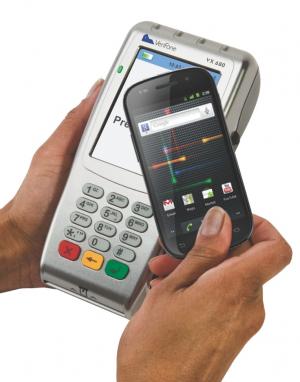
About 25% to 30% of merchant locations in the United States will need to be covered by contactless terminals if service providers and mobile operators hope to get consumers interested in tapping their NFC phones for retail transactions, says POS terminal vendor VeriFone.
Hitting that target–a contactless penetration rate 10 times greater than it is today–will not be easy, but it is achievable in the next 18 to 24 months, thanks largely to planned mobile-payment and mobile-commerce schemes from such new players as the Isis joint venture and Google, predicts Paul Rasori, senior vice president of global marketing at VeriFone.
"There’s a perfect storm brewing (with) Google and Isis alone and their ability to drive a market because of their reach," he told NFC Times. "I don’t think there are two better organizations to test those waters because of their massive consumer reach. They are creating applications that consumers will want to use and merchants will provide them access to."
Isis, a joint venture of three of the four largest U.S. mobile operators, AT&T, Verizon and T-Mobile USA, plans to launch its own payment scheme and other applications on NFC phones next year. Google is building a mobile wallet for its popular Android smartphone operating system, and is expected to roll out retail couponing, loyalty and location-based mobile advertising and marketing services, many of which will use NFC. Payment applications, though probably not issued by Google itself, will also go into the wallet.
Google in Talks with Retail Players
Google has been talking to large U.S. merchants, along with the country’s largest merchant acquirer and processor, First Data, to put its mobile-commerce plan into effect, NFC Times has learned. The Web giant has also been rumored to be in discussions with such POS terminal and reader vendors as VeriFone itself, including possible talks about introducing new types of terminals.
 Rasori declines to talk about any discussions with Google or other planned NFC-enabled schemes. But VeriFone, which claims a 60% to 65% market share of the U.S. POS terminal market, could provide an important link for Google’s m-commerce platform with U.S. merchants.
Google’s outgoing CEO, Eric Schmidt, has called NFC combined with smartphone technology a mega-scale opportunity, enabling Google to expand its lucrative Web advertising business to the physical point of sale, where most commerce is conducted.
But there are other prospective players that seek to move their big e-commerce businesses "offline," to the physical point of sale, that could drive merchants to deploy contactless terminals, said Rasori. These include Internet payment scheme PayPal and deal-of-the-day e-commerce site Groupon.
With a range of contactless-mobile applications, the new players could energize a lackluster U.S. contactless payment-card market, which can boast of only about 150,000 merchant locations in the United States nearly six years after the rollout began. That’s fewer than 3% of the U.S. merchant outlets that accept conventional payment cards.
"In any given geography, with mobile phones, 2% to 3% (NFC acceptance), obviously that’s not going to fly," Rasori said. "You achieve 25% to 30% penetration, that becomes interesting to the consumer. Consequently, merchants take notice of people using this in a meaningful way, and the final 70% could happen quickly."
VeriFone’s Evolving Business Model
Of course, VeriFone is angling for business. The company, which had $1 billion in sales last fiscal year and will become the largest POS terminal vendor worldwide with its pending acquisition of the No. 3 supplier, U.S.-based Hypercom, hopes to sell many of the new terminals. It also seeks to offer the expanded terminal software to support the range of services that Google and other new service providers are expected to roll out.
In fact, the company and its aggressive CEO, Doug Bergeron, see big potential profits in the new mobile wallets and services beyond just terminal hardware. VeriFone calls the planned NFC M-commerce rollouts a "disruptive paradigm shift" and sees them as an opportunity to sell merchants and service providers on bundled services to manage what would become an increasingly complex POS environment.
The bundled services will include maintenance and upgrades. The company might also offer some trusted service management, including TSM services for some applications in the wallets. Rasori, however, said VeriFone does not yet have a TSM partner. And the focus is on the POS terminal.
Calling on Service Providers to Pay
In a rather brash move, Bergeron in a recent press release called on the new NFC service providers–presumably such companies as Google, Isis, as well as the conventional payments players, such as banks and card schemes–to foot the bill for upgrading and maintaining the infrastructure needed for the coming era of NFC m-commerce. This would include the software for the terminals.
"Until retailers are assured of receiving real value from mobile commerce, service providers who stand to gain from either carrier fees, advertising revenue or transaction charges must be willing to bear the costs of this highly disruptive paradigm shift," Bergeron said in a statement.
Without the service providers paying the upfront costs of the infrastructure to manage such smartphone-based retail applications as payments, e-couponing and social networking, these services could go the way of previous alternative-payment schemes that "only succeeded in alienating merchants," contends Bergeron.
Rasori said most POS terminals in the United States already support applications from the four open-loop payment-card schemes. These application have to be maintained regularly, he noted. But add in the new payment and other services and the environment becomes "tremendously complex."
"If you start with Visa, MasterCard, American Express and Discover, and (then) adding Google, Isis, PayPal, Groupon, there could be up to 10 to 12 different applications that need to be maintained," he said. "Our message is, don’t assume that the merchant should or will support the rollout of the infrastructure. It’s in the best interest (of the service provider) to have skin in that game."
Not Giving Away Readers
Rasori said recent reports in some publications saying VeriFone would include NFC in all its new POS terminals, enabling merchants to automatically accept contactless payment, were incorrect. Merchants ordering terminals would have to specify that they want a contactless reader and pay extra.
 Facebook
 Twitter
 LinkedIn
HEADLINE NEWS


Syndicate

