HEADLINE NEWS
Transport for London Blames Complexities for Missing Olympics Deadline for Open-Loop Payment

Transport for London has confirmed it will miss its deadline for accepting open-loop credit and debit card payments on London buses in time for the start of the Summer Olympics.
Shashi Verma, the transit authority’s director of customer experience, said riders would only be able to tap to pay fares with their contactless bank cards on a small number of buses starting next month, not the 8,500 buses that the big transit authority had initially planned. Verma’s original goal was to introduce open-loop payment of fares in 2011.
Transport for London has reportedly moved the rollout of contactless bank card acceptance on buses back to the end of the year. And expansion of open-loop payment on the London Underground and other modes of transport managed by the authority won’t get started until 2013 or beyond.
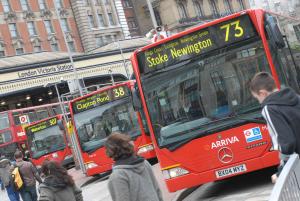
“We will only roll it out once we are confident it is 100% robust,” Verma said in a statement, noting that the authority would begin “implementing and testing” open-loop payment on a small number of buses in June.
“Bringing this revolutionary contactless debit and credit card payment system to the transport environment has involved complex development work in conjunction with the card payments industry, and our priority has always been to ensure all of the systems are right and robust before a widespread rollout,” he said. “This has led to a shift in our initial forecasts.”
Accepting open-loop bank card payment of fares on buses is considered the easy part of the two-phased project, since buses do not charge distance-based fares and riders only tap once, when they board.
The massive London Underground, part of phase two of the project, will require riders to tap in at entrance gates and tap out at their departure stations, so distance-based fares will need to be calculated, along with other fare policy.
This will require a sophisticated back-office system to figure fares that now are calculated at the gate. Payment schemes, such as MasterCard Worldwide, have developed special authorization systems to collect transit fares with cards supporting their contactless applications, such as PayPass.
A source at U.S.-based Cubic Transportation Systems, the systems integrator for the project, told NFC Times that while open-loop bus fare collection is not as difficult as accepting bank cards at Underground gates, it still requires much more complex terminals. These have to support not only contactless EMV cards running Visa payWave, MasterCard PayPass and likely ExpressPay from American Express, but also Transport for London’s existing closed-loop Oyster cards and a third application, ITSO, the UK’s standardized transit fare-collection system.
And all three application types have to tie into different back-end systems, said the source.
“Oyster sends it to one system, contactless EMV transactions send it to a different system and ITSO transactions to another system,” he said. “To get all that operating on a single terminal is a big deal.”
New Use for Contactless Bank Cards
Banks and payment schemes see transit fare-collection as a major new “merchant” category for contactless bank cards, giving consumers more reasons to tap the cards to pay.
MasterCard has been active in helping transit authorities, such as Transport for London, to gear up for open-loop payment.
“We do believe that the TfL (Transport for London) launch will bring a significant boost to the use of PayPass for direct payment of transit fares and would, therefore, like to see this key project go live as soon as possible,” Mike Cowen, head of transit in Europe for MasterCard, told NFC Times. “However, this is a large and complex infrastructure project and, therefore, it is not altogether surprising that some hurdles should be encountered along the way.”
Transit authorities in Chicago, Philadelphia and a few other cities, including New York, are also planning to accept contactless bank cards.
Once in place, the same terminals onboard buses and at subway, train, tram and ferry gates that accept contactless bank cards also could accept open-loop contactless payment applications loaded onto SIM cards or other secure elements in NFC phones.
But even if Transport for London and Cubic were to have hit the deadline for launching open-loop payment on London’s 8,500 buses in time for the Olympics, the British riding public still probably couldn’t tap their NFC phones to pay, since Transport for London is not planning to accept prepaid open-loop applications on the buses, only credit and debit.
This is probably because prepaid bank cards have to go online for authorization with each transaction to ensure funds are available in the user’s account. This is not practical for buses or at London Underground gates or other transit terminals.
No NFC Transit Ticketing for Games
But the only NFC payment commercial launch to date in the UK, Quick Tap from mobile operator Orange and issuer Barclaycard, so far only offers prepaid payment.
It will be different when contactless-EMV payment is launched at London Underground gates. It still will be infeasible to do online authorizations for each transaction. But Transport for London plans to accept prepaid bank cards, along with credit and debit, at the Underground gates since a special transit authorization system will be in place to handle these transactions. This system is designed to reduce costs for fraudulent transactions, cutting risks for accepting prepaid.
Of course, visitors to London from other countries, where NFC-based credit and debit applications are available, such as Turkey, France and, soon, Poland, could probably have tapped their phones to pay for fares on London buses.
And Olympics sponsors Samsung Electronics and Visa Europe plan to release a commemorative version of Samsung’s NFC-enabled Galaxy S III supporting Visa’s contactless payment application payWave, issued by Lloyds TSB bank. This might be a credit or debit application.
The point is moot, however, with the failure by Transport for London and its suppliers to be ready in time for the opening ceremonies.
It means that what contactless backers hope will be a true contactless Olympics this summer is getting off to an uninspiring start.