HEADLINE NEWS

Orange Group NFC Veteran Barnaud Departs for Wallet Vendor C-SAM

U.S.-based mobile-wallet provider C-SAM has hired Vincent Barnaud, the long-serving contactless services head at France Telecom-Orange group.

Telco and Bank in Brazil to Launch NFC Pilot; Rollout to Follow

Mobile operator TIM Brasil and Banco Bradesco have disclosed plans for an NFC trial that they say would enable users to pay for purchases at contactless point-of-sale terminals by tapping their Motorola or LG Electronics NFC phones, with the funds deducted from their debit accounts.

Taiwanese Telco and Banks Announce Plans for NFC-Payment Projects

May 29 2013 (All day)

Taiwan’s largest mobile operator, Chunghwa Telecom, and four banks announced plans today to launch NFC mobile payment, likely starting with Cathay United Bank and a six-month pilot.

Isis Gears Up for National Launch Despite Challenges Ahead

The Isis joint venture continues to gear up for a nationwide launch of its NFC-enabled Isis Mobile Wallet this year and has been in discussions with major U.S. banks along with merchants, NFC Times has learned.

MasterCard Prepares to Offer PayPass on Embedded Chips in Samsung NFC Phones

MasterCard Worldwide is the latest payment scheme to work with Samsung Electronics, with plans to soon offer its PayPass application for embedded chips in new Samsung NFC phones, NFC Times has learned.

UK Taxis Get NFC Tags for Promo Campaign; NFC Dynamic Screens to Play at French Sporting Event

Samsung Electronics, along with Australia-based NFC marketing firm Tapit, UK-based out-of-home advertising company Chiel and terminal vendor VeriFone are rolling out NFC stickers to 80 taxis in the UK, as part of a promotional campaign for musician Robbie Williams’ upcoming Samsung-sponsored tour.

Visa Europe: Contactless Transactions to Continue to Grow Rapidly in 2013

Consumers in Europe did 19 million transactions with Visa-branded contactless bank cards in March, up by nearly 50% from December, announced Visa Europe Tuesday, which predicts monthly transactions will increase to 52 million by the end of 2013.

OTI to Supply Contactless and NFC Readers for Gasoline Stations in North America

Israel-based contactless and NFC vendor On Track Innovations announced Monday it had received an order for 30,000 readers for point-of-sale terminals at retail gasoline stations in North America.

Taxis in Major U.S. Cities to Get NFC-Enabled Video Ads

Riders in 5,000 taxicabs in the U.S. would be able to tap on NFC tags on video advertising screens to download apps, brand information, coupons, maps, music and videos, according to technology suppliers that have equipped the taxis for potential advertising campaigns.

Royal Bank of Canada and Bell Mobility Announce Plans for NFC Launch

May 14 2013 (All day)

Canada’s largest bank and one of its three major mobile operators have announced plans to commercially launch NFC payments by the end of the year, following a trial this summer.

Analyst: Banks Have More to Fear from Cloud-Based Technologies Than NFC

Banks have much more to fear from cloud-based mobile payment than from NFC, even if mobile operators control the secure elements that hold the banks’ payment applications.

GSMA Proposes Global Standard for NFC-Enabled Loyalty and Couponing–Using SIM Cards

May 10 2013 (All day)

The GSMA mobile operator trade group is proposing a global standard for how point-of-sale terminals talk to NFC-enabled mobile wallets to enable consumers to redeem coupons and rewards.

London Bus Riders Can Tap Bank Cards to Pay Fares; NFC Acceptance Unlikely for Now

Transport for London officially announced the launch of the first phase of its open-loop payment service, allowing riders to tap their contactless credit, debit and charge cards to pay fares on more than 8,000 buses.

As earlier reported, the launch of the service–while delayed from its planned unveiling during the Summer Olympics and only in its first phase–still makes London the first major city anywhere to allow riders to directly pay their fares with open-loop bank cards.

“The eyes of the transit world are upon London,” Mike Cowen, head of transit solutions, Europe, for MasterCard Worldwide, told NFC Times, noting that he’s been working on the project with Transport for London for more than five years. “All over the world, they are closely monitoring what’s happening in London.”

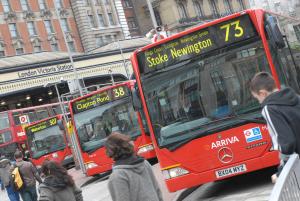
Starting today, contactless bank cards supporting MasterCard PayPass, Visa payWave and American Express ExpressPay–though generally not yet applications on NFC phones–are accepted on 8,500 buses that serve the UK capital, with onboard terminals upgraded to accept these applications in addition to Transport for London’s closed-loop Oyster card.

Banks and card payment schemes hope the service will substantially increase use of contactless credit and debit cards in the UK, which, while growing fast, still account for a very small number of total card transactions. Transport for London in its announcement today said estimates call for 25 million bus journeys to be paid by contactless bank cards in the next year.

That’s about double the contactless transactions at retail outlets that Barclaycard and its parent Barclays bank are seeing this year from their 19 million combined credit and debit cards–though these transactions are up by 200% from 2011, Barclaycard noted. Barclays and Barclaycard have issued the majority of contactless bank cards in circulation in the UK and also have deployed most of the more than 100,000 contactless terminals in the country. Barclaycard led the UK’s contactless payment launch in September 2007.

Issuers and card schemes are hoping open-loop fare collection becomes a major category of contactless transactions in itself, but also will have a knock-on effect to encourage consumers to tap to pay more often for purchases at retail outlets.

Transport for London estimates riders still pay for more than 85,000 bus trips each day with cash, even though they are charged a much higher single-journey fare–of £2.35 (US$3.80), or 70% more than paying with Oyster cards. Those paying with contactless bank cards will get the lower fare.

In addition, 36,000 people who board buses and try to pay with Oyster find they don’t have enough value on the cards–something that wouldn’t be a problem with contactless credit, debit and charge cards, noted Transport for London.

Dave Chan, CEO of Barclaycard Consumer Europe, told NFC Times today that he expects many more UK merchants to accept contactless over the next six to 12 months, including more tier-one chains. The launch of open-loop fare collection on buses by Transport for London will add to the momentum, he said. 

“They (consumers) have a good reason now to get used to and adopt the technology,” Chan said, adding that merchants around train stations could be among the first to adopt contactless, if they haven’t already. “You know there will be customers coming,” he said. “You’ll want to make that available. You’ll want to have the technology.”

Payment from NFC Phones Not Yet Accepted
But British consumers will not yet be able to tap their NFC phones to pay, since the only NFC-payment service launched to date in the UK, Quick Tap from Orange UK and Barclaycard, carries a prepaid PayPass application Barclaycard issues.

Prepaid contactless bank cards and NFC applications need to go online for authorization–at least under the present system in the UK. And Transport for London’s fare-collection system does not allow for that in the first phase of the open-loop fare collection project.

And even out-of-town visitors with credit or debit applications on NFC phones, for example from Turkey or Poland, might not be able to pay for fares on London buses by tapping their phones, since these applications are often programmed to go online for authorization, too, in their home countries.

This situation is expected to change when Transport for London moves to phase two of its open-loop fare collection project.

That is the much more difficult part of the open-loop project, in which Transport for London will enable customers to pay for trips on the London Underground and other modes of transport.

Phase Two More Challenging
This will require the back-end system to calculate distance-based fares, as well as volume discounts and other flexible fare policies. That will include fare capping for riders, who only pay for a certain number of rides per day, after which they are not charged. 

Plans for phase two also call for acceptance of prepaid applications for all transport modes, including buses, with authorization conducted after the rider enters the system, though not immediately upon tapping.

Transport for London has said it will launch phase two by the end of 2013, but delays would not be surprising since it requires the authority to put in place a sophisticated back-end system to calculate the fares.

Fares with Oyster today are calculated on terminals, though with open-loop payment, there will still be work for the terminals to do to keep out fraudulent bank cards using blacklists.

U.S.-based Cubic Transportation Systems, which implemented the Oyster system, is also providing the terminal upgrades and systems integration for the open-loop project.

Transport for London and Cubic were six months late with the launch of phase one of the open-loop project, even though it is the much simpler of the two phases. In phase one, the system is only required to deduct a straight £1.35 for single-journey fares–without having to calculate any discounts or other flexible fare policy. The card-based single-journey fare is expected to increase slightly next year.

Transport for London last May blamed the delay in launching bank card payment on buses on “complex development work in conjunction with the card payments industry.”

Shashi Verma, director of customer experience for Transport for London, had originally intended for open-loop payment to launch even before 2012, as the authority seeks to reduce its expenses for changing money and operating the expensive Oyster system.

“Offering contactless payment on London's buses, alongside Oyster, is the first step in becoming the world's first transport network, where customers can travel between bus, Tube (Underground) and rail by touching in with a contactless payment card,” Verma said in a statement today.

Interest in Account-Based Fare Collection
Some other transit authorities and operators are interested in opening up their fare-collection systems to contactless banking cards, though they appear to be mainly in U.S. and Canadian cities. But cities such as Manchester, in the UK, are also planning to expand to open loop.

The major U.S. cities include Chicago, Philadelphia, New York and Washington, D.C. The Chicago Transit Authority is furthest along, and in September announced that its open-loop system, called Ventra, is scheduled to launch next summer. The system will feature both open- and closed-loop applications.

It remains to be seen how well riders take to using their bank cards for paying fares, said fare-collection consultant Gary Yamamura, a principal at U.S.-based Three Point Consulting.

But the move to open loop is part of a related trend that is just emerging for transit agencies, at least those in North America, to go to account-based fare collection–whether using open- or close-loop cards, he said. It moves the intelligence of the payment service from the card and terminal to the back end.

“I don’t need all that intelligence in a thousand field devices,” Yamamura told NFC Times. “I need that intelligence in the central system, which is one or two servers. So, if I need to make a change, I just need to make it in one place.”

The trends differ for different regions. In Asia, for example, most fare-collection companies–while often owned at least in part by transit agencies–are in business to collect fares. And they have been expanding their closed-loop fare-collection schemes to the retail point of sale, led by Octopus Cards, and including schemes in Tokyo, Taipei, Singapore, Seoul and Kuala Lumpur.

Transport for London looked into the proposition of expanding its closed-loop fare-collection service to retail several years ago, but rejected the idea. And now it is keen to get out of the business of payments and ticketing as much as possible.

“In London, just like every other transit system in the world, if you want to use the system, you have to buy a token,” said MasterCard’s Cowen. “Before you can travel, you have to go through that first step. That first step represents inconvenience to users and cost to the transit agency.”