HEADLINE NEWS
Secure MicroSD Venture Led by Giesecke & Devrient Liquidates

Germany-based smart card company Giesecke & Devrient and Taiwan-based flash memory chip supplier Phison Electronics have dissolved their joint venture that had targeted the market for microSD cards to store mobile-payment applications.
The two companies formed the joint venture, Giesecke & Devrient Secure Flash Solutions, in October of 2009, together investing an estimated €3 million (US$4.5 million). G&D owned a reported 70% of the company, while Phison held the remainder. Phison in 2009 confirmed it had invested €900,000 for its 30% stake, which would indicate G&D put up €2.1 million in initial funding.
To enable mobile payment, the venture had originally intended to produce microSDs with an embedded antenna that could give non-NFC phones a contactless interface. It later switched its development to microSDs that could connect via a single-wire protocol, or SWP, connection to NFC chips and antennas in full NFC phones.

While the joint venture was small, its liquidation casts some doubt on the market for microSDs that work in full NFC phones. But in disclosing that the companies had dissolved the joint venture, effective at the end of 2012, G&D said it might continue to supply secure flash memory products.
“The parent companies find it is currently more effective to support the relevant business directly by themselves rather than by the joint venture,” said the joint venture’s Web page.
The company also supplied secure USB flash drives, among other secure flash products, that could be used for enterprise applications and others. It had a total of 11 employees.
But the high-profile product from the venture was the microSDs that could be used for payment in full NFC phones and could offer an alternative secure element to SIM cards and embedded chips.
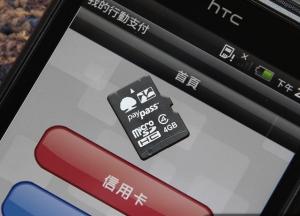
Giesecke & Devrient Secure Flash Solutions, or G&D SFS, supplied microSDs to Taiwan’s Cathay United Bank for a trial that launched last June. The trial tested a MasterCard PayPass credit application and a separate Mifare-based EasyCard e-purse on microSDs that were inserted in a modified version of the HTC Incredible S.
The Android phone from Taiwan-based HTC was equipped with an NFC chip and antenna and an SWP connection to the microSD card slot.
Cathay United reportedly issued 2,000 of the microSD cards for its trial. There were some complaints about poor performance of the HTC phone working with the applications on the microSDs.
The project was the first of its kind outside of China, where payment network China UnionPay and at least two banks, including China Construction Bank, launched NFC mobile payment on microSDs in the HTC phone in late 2011. Other companies, Wuhan Tianyu Information Industry of China and Taiwan-based Go-Trust, the latter working with China-based Eastcompeace, supplied the “SWP-SD” cards for the Chinese project.
A source involved in the Chinese project told NFC Times that only about 10,000 of the specially equipped HTC phones had sold as of last summer, with the time needed to gear up for the launch meaning that the phone didn't go on sale until the fourth quarter of 2011, at least eight months after the non-NFC version of the HTC phone had hit the market.
Four Chinese banks, including Construction Bank, had issued a combined 200,000 microSDs supporting the technology, but most are used for securing remote payment, not NFC payment.
In addition to the poor takeup of the SWP-SD cards, China UnionPay is now working with China’s three mobile operators, including China Mobile, to put payment applications on the telcos’ SWP-based NFC SIM cards. UnionPay, however, might continue to pursue NFC mobile payment with microSDs at the same time.