HEADLINE NEWS

ZTE: Europe is Next Target for NFC Phones

China-based phone maker ZTE indicated it will be targeting Europe with its NFC phones, although it did not specify models or release dates.

Samsung to Embed Secure Element in Galaxy S III, Other NFC Phones

May 14 2012 (All day)

Samsung Electronics and NXP Semiconductors have confirmed that Samsung’s next flagship smartphone, the Galaxy S III, will sport an embedded secure chip, in addition to supporting applications on SIM cards.

American Express Onboard for Isis Two-City Launch

American Express and Isis have announced that AmEx plans to participate in the two large NFC pilots Isis plans to launch this summer in Salt Lake City, Utah, and Austin, Texas.

HTC Steps Up NFC Phone Presence with Three High-End Handsets

May 10 2012 (All day)

New Orleans – Phone maker HTC is displaying three high-end NFC phones at the International CTIA Wireless show in New Orleans, including its Droid Incredible 4G LTE, destined for U.S.

MasterCard Unveils Wallet Offer; Expands PayPass Name to Online Transactions

NEW ORLEANS – MasterCard today announced its answer to Visa’s digital wallet and other wallets planned by competitors, introducing its PayPass Wallet Services.

MasterCard Announces NFC Device Certifications; New NFC Mark

May 9 2012 (All day)

MasterCard has announced certifications for 17 NFC phones as well as its own mark that handset makers could display on device packaging, advertisements or even on the devices themselves, showing the phone is able to do contactless payments with MasterCard PayPass.

Samsung Unveils Galaxy S III, Supporting NFC Payments and Enhanced P2P

May 4 2012 (All day)

Samsung Electronics has introduced its much-anticipated Galaxy S III, which, as expected, will support NFC for mobile payment, along with an enhanced version of Google’s Android Beam peer-to-peer pairing-and-sharing feature.

Barnes & Noble First E-Reader Seller to Disclose Plans for NFC Support

In a first for an e-reader seller, the CEO of bookstore chain Barnes & Noble said the company plans to include NFC chips in its Nook e-readers, which he said could make the connection between the devices and the company’s physical stores.

Airline to Introduce NFC App Following Successful Sticker Launch

May 3 2012 (All day)

Scandinavian Airlines plans to introduce an NFC application for frequent flyers as early as this summer, enabling those with Android NFC phones to tap for a faster flow through check-in, security screening and boarding.

Report: Google and PayPal Challenge UK Joint Venture Plans

Google and PayPal have reportedly expressed concerns to European antitrust regulators, saying they fear that if major UK mobile operators are allowed to form their proposed NFC mobile-commerce joint venture, they would have too much power to control secure elements in NFC phones, the Financial Times reported Sunday.

Telefónica UK Launches O2 Wallet; Promises NFC Later in 2012

Telefónica UK, known as O2, launched its long anticipated O2 Wallet today, offering text-based money transfers and online product searches and purchasing, but no NFC yet.

Wentker Departs Visa; Bains Leaves GSM Association

Dave Wentker, considered the No. 2 man in Visa Inc.’s mobile-payment unit and a former vice chairman of the NFC Forum, has left the payment network after more than 15 years, NFC Times has learned.

Maker of Rugged Phones Enters NFC Market; is Its Price Right?

By: 
Dan Balaban

Sonim Technologies, the maker of rugged work phones, has introduced its first NFC-enabled handset, betting that cleaning companies, security guard firms and home-health care agencies are ready for a more durable–and higher-priced–NFC phone for workforce management.

Sonim’s XP1301 CORE NFC, is designed to survive two-meter drops onto concrete, dunks in toilets and other rough treatment by employees, who could be asked to tap the phone dozens of times per day to register time and attendance and use other work-related applications.

But while Sonim says its new NFC handset will last years–offering a three-year warranty that includes coverage for accidental damage–and touts the “longest battery life for NFC usage” of any phone on the market, the XP1301 also costs twice as much or more than most NFC handsets now used for workforce management.

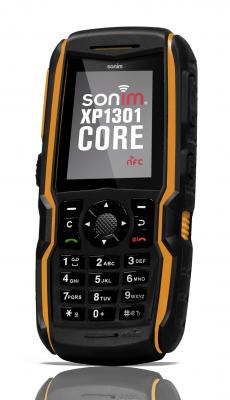
That might be a problem for the phone to reach wide deployment across various industries, especially since mobile operators have yet to show much interest in subsidizing phones for workforce management. But at €355 (US$477.38), the Sonim phone is still priced lower than many high-end smartphones.

While not garnering the attention of such high-profile NFC applications as mobile payment and ticketing, workforce management–which helps companies keep track of the location and productivity of their employees in the field–has been the most common use for standard NFC phones over the years.

That will soon cease to be the case as consumer applications, including payment, ticketing, couponing and device pairing, finally begin to take off as more NFC-enabled smartphones hit the market. But NFC time and attendance and related applications could become an important market, say observers. At present, the number of users are in the low hundreds of thousands.

Sonim is the first company to produce an NFC phone purely for this enterprise market since Nokia shipped its first NFC device seven years ago, an NFC-equipped back cover attachment for its 5140 ruggedized phone.

Since then, workforce management companies, nearly all of them doing business in Europe, have been using NFC handsets intended for the consumer market. These have mainly been feature phones, such as Nokia’s 3220, 6131 and 6212 handsets and the Samsung's S5230. More recently, the firms have distributed the C7 Symbian smartphone from Nokia and, in a few cases, Google’s Nexus S.

Interviews by NFC Times with a sampling of the workforce management companies show that the firms generally welcome the addition of the Sonim phone. Some sources at the companies noted that with the three-year warranty–compared to two years for most other NFC phones–the Sonim XP1301 could easily be worth the extra money.

World’s Toughest Phones and Nurses?
But that depends on the particular industry they are supplying phones for. An “ultra-rugged” phone, which can withstand a temperature range of 55-degrees Celsius (131F) to -20C (-4F) and submersion in two meters (6.6 feet) of water for up to 60 minutes, could come in handy for a range of industries, including workers at construction sites and maintenance crews using heavy-duty cleaning solutions, they said.

For home-health care agencies, however, one of the biggest users for NFC-based workforce management systems, a phone from a company that recently earned a Guinness world’s record for having the “World’s Toughest Phone,” might be overkill, said some.

Home-health nurses visit patients in their homes, often tapping the patients’ contactless cards or tags in their homes to register the visit. The system then often sends up-to-date patient-care instructions to the nurses over the mobile network, and they might tap other tags and send back diagnostic data and photos. Some workforce management companies have experimented with sending digital-door keys to NFC phones enabling the nurses to tap to enter a patient’s front door.

“Health-care services are not that extreme surroundings,” said Oliver Brech, an IT specialist at Luxembourg-based Tuomi IT, which specializes in time and attendance and other workforce management systems. “The Sonim phone is made for extreme conditions. If (other phones are) used in normal conditions, they should last for a long time.”

But he added, however, that the Sonim XP1301 is not much more expensive than the Nokia C7 without operator subsidy, and the unsubsidized Nexus S is even more.

Pushing the Panic Button–If Available
And the XP1301 also has a panic button that nurses and other field workers could press in case of emergency. It automatically sends out an alarm to their employers requesting help. That wouldn’t work on many consumer phones, such as the C7, which has a screen-based electronic keypad that is not on the home screen.

“Some health care organizations are interested in using this model for some nurses visiting patients during the night,” said a source with another workforce management company who asked not to be named. “Of course, the (Sonim) price is too high (to distribute the phone) for all the nurses. At the moment, Android NFC phones are offered for €100.”

But NFC-enabled Android phones for €100 are not on the market, at least not yet.

And according to Magnus Maurex, CEO of Sweden-based workforce management Avista Time, the Sonim phone has other characteristics that would make it worth the money besides durability. The phone lasted six days in round-the-clock tests with NFC tag-reading and other operations. That compares with a battery life of eight hours–or one shift–for the Nokia NFC phones the firm has been using.

“Especially in elderly care, they (nurses) share the phones,” he told NFC Times. “That means the phone goes around basically for 24 hours, and in high capacity. Six days–that’s powerful.”

Sonim promises up to five days of battery life with “continuous NFC operations with 20 tag reads and server updates per hour.”

Sonim: Other Phones Not Available or Robust
Avista Time, among other workforce-management companies, was given samples of the Sonim phone to test and develop applications for, and they lent their names to Sonim's press release this week announcing the phone. But Maurex said he wasn't given anything extra by Sonim for promotional consideration.

Sanjay Jhawar, vice president and general manager for marketing and applications at Sonim, said workforce management companies such as Avista Time, Finland-based Reslink and Spotmaster of the Netherlands, have told him that workers they supply with NFC phones often tap the phones to read tags 10 times per hour. That drains battery life, and every hour the phone is charging is an hour it can’t be used by workers, he said.

He contends the Sonim phone has better tag-reading capability than competing phones and also can run NFC applications in the background, so a phone call to the worker doesn’t interfere with an NFC operation.

But Sonim appears to be selling its tough phone against Nokia and Samsung by first stressing its durability.

“Many of those (workforce management services) run on other Nokia, Samsung, and Sagem products, and these are companies that have told us those other phones are either not available or not sufficiently robust,” Jhawar told NFC Times. “We’ve had customers tell us, in some work environments, their phones last 60 to 90 days before having to be replaced.”

Jhawar said the higher price of the Sonim phone compared with most other phones used for workforce management is not preventing cleaning companies and other service firms with thousands of employees from ordering the phones or specifying them to their software firms and systems integrators.

“We have thousands of units on preorder that will be shipping,” he said, adding: “It (XP1301) isn’t likely to break. This kind of total cost of ownership looks very attractive compared with consumer products that is not really designed for this use.”

Jhawar said Sonim chose an NFC chip from France-based Inside Secure because its read range with the antenna in the Sonim phone is 2 to 4 centimeters. Inside also was more willing to work closely with the company to integrate the chip and its open NFC middleware into the phone, Jhawar said.

“(With some phones), you literally have to not only physically touch (but) sort of touch and rotate in multiple directions to get the tag to read,” he said. “Most of these companies were frustrated with solutions that they had already tried, like these Nokia solutions, which weren’t really made for the workforce management applications.”

Jeremy Belostock, head of NFC at Nokia, refused to be drawn into a debate over the merits of Nokia’s phones versus the new Sonim phone for workforce management.

“It depends on the working environment,” he told NFC Times. “If you’re worried about the phone falling repeatedly or being dropped from heights, you want a ruggedized phone.”

But when pressed, he added: “There is a need for a lower-cost phone.”

Avista Time’s Maurex said that since 2004 he has used Nokia phones for NFC-based home-health care, cleaning and security guard workforce management services his company offers. He agreed that the Nokia 6212 feature phone introduced a few years ago was not good at reading tags, but its predecessor, the Nokia 6131, had excellent tag-reading capability.

He also said the older Nokia phones have lasted four to five years, but they typically need one or two new batteries over the course of five years. And some need to be refurbished from time to time, including new screens and rubberized keypads, at a cost of about €70. 

Many of the older Nokia phones, especially the Nokia 6212s, are still in use.

Sonim has been working on the XP1301 Core NFC phone for more than 18 months. NFC Times reported last year the phone was due out in mid-2010. But Sonim’s Jhawar said the phone has not been delayed.

Telcos Hold Back
And now that it’s available, he said he’s not worried about convincing workforce management companies or their clients to buy it.

The challenge is to get mobile operators to subsidize and distribute NFC phones for big enterprises, such as cleaning companies and other service firms with tens of thousands or hundreds of thousands of workers. Sonim also hopes to expand use of NFC phones for workforce management to North America, from its European base.

Operators seem most keen on using NFC to roll out mobile payment and ticketing in the consumer market–with the secure applications stored on SIM cards they issue. These NFC phones would support a single-wire protocol connection between the NFC chip and SIM card slots.

But Jhawar said telcos have expressed some interest in the workforce management market, which could enable them to lock in mobile contracts with companies with large workforces. They could sell the NFC phone as a way for the companies to save money by improving employee efficiency, he said.

“It’s (workforce management) nothing to do with mobile payments; it’s nothing to do with the single-wire protocol, (but) these (service) companies have a very good return on investment.” NT