HEADLINE NEWS
Large UK Trial with iPhone Add-On is First Foray into M-Payment by RBS Group

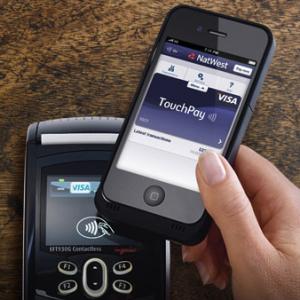
UPDATED: UK bank NatWest has enabled 1,000 customers to tap to pay with Visa payWave using the iPhone 4 and 4S equipped with an NFC-enabled attachment, representing the first foray into mobile payment by the Royal Bank of Scotland Group.
The trial of the TouchPay service uses the iCarte add-on from Canada-based Wireless Dynamics, which carries an embedded secure element that will store the Visa payWave debit application. The attachment also sports a full NFC chip. Users can tap to pay at about 140,000 point-of-sale terminals accepting payWave in the UK and others abroad.
It's believed to be the first major NFC or contactless-mobile payment project by any part of the RBS Group, which is NatWest's parent. NatWest is RBS's major retail banking unit in England and Wales. RBS held a small internal trial of NFC payment five years ago at its Edinburgh headquarters.
“Other than that, this is first foray into NFC,” Jose Quesada, TouchPay product manager, told NFC Times. “With the advent of TouchPay, we are really moving to mobile payment.” But he was quick to add that RBS has not yet committed to rolling out TouchPay. That decision, in part, will depend on results of the four-month trial with the case for the iPhone 4 and 4S.
Quesada said that while the bank would consider expanding the service to Apple's new iPhone 5 when the NFC-enabled attachment is available, it was not ready to confirm that, either. But according to Visa Europe, which announced the launch of the RBS TouchPay project Tuesday, the service “will be made available to all RBS and NatWest customers who have Apple iPhones in the near future.”
The bank's TouchPay pages on NatWest’s site–which the bank posted this summer to recruit users–said that the trial would last for four months and at the end of it users would no longer be able to make payments with the iPhone attachment. The site attracted 9,000 customers interested in participating in the trial, which includes a free attachment for the 1,000 selected users.
RBS decided not to wait for an iCarte version supporting iPhone 5 because it didn't know when the attachment would be ready and a high percentage of its mobile-banking customers use the earlier iPhone versions covered by the latest iCarte attachment, the 420, which is certified by Visa, Quesada said.
The significant use of the iPhone by NatWest mobile-banking customers is also a major reason the bank decided to launch the TouchPay project with the iPhone case and not a full NFC handset. Quesada gave no indication the bank was trying to avoid mobile operators by putting its application on the embedded chip in the iCarte.
“We do recognize and value those customers who have got an Android phone or BlackBerry phone,” he told NFC Times. “We are working towards expanding TouchPay to every customer who would like to use it, not only for iPhone platform, but for all the platforms.” But he added: ”We don’t have a date.”
Wireless Dynamics CEO Ambrose Tam told NFC Times the vendor is working on a version of iCarte for the iPhone 5, and said plans call for it to be available and certified by Apple and presumably Visa by the end of 2012.
It remains to be seen whether the company can hit that deadline, since some previous iCarte versions have taken longer following Apple’s iPhone releases.
The RBS Group's five-year silence in contactless-mobile or NFC payment trialing is in contrast with rival Barclays bank and its Barclaycard unit. The latter in 2011 launched a small commercial NFC rollout, which recently added the Samsung Galaxy S III to the limited lineup of phones available for the service. Another large UK bank, Lloyds Banking Group, participated in the recent Olympics Phone trial organized by Visa, which also featured the Galaxy S III.
Use of the iCarte would not require banks to put their applications onto SIM cards issued by network operators. Among banks that have used the attachment for pilots or small commercial launches have been Commonwealth Bank of Australia, Turkey’s Yapı Kredi, and Komerční bank in the Czech Republic, as well as telco KT Corp. in South Korea.