HEADLINE NEWS
Pioneering NFC Service Provider Adds Bar Codes to New NFC Trial

Transit officials in Frankfurt have launched a six-month trial enabling riders to use their mobile phones with either NFC-based tags or 2-D bar codes to quickly get scheduling updates and information on connections and special offers at nearby restaurants, theaters and other venues, while riding on trains.
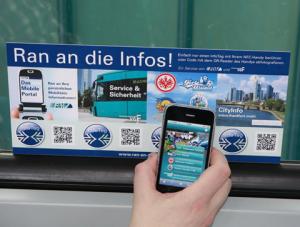
The trial, launched Friday by transit authority RMV and Frankfurt metro and bus operator VGF, will deploy small posters on trains on five lines of the Frankfurt metro along with a tram line. The posters are embedded with both RFID tags and QR bar codes.
While RMV is a pioneer in the use of Near Field Communication for transit ticketing, the fact that it’s adding bar codes to the service-discovery mix is recognition that few riders in Frankfurt–or anywhere else for that matter–carry NFC phones, said RMV spokesman Peter Vollmer.

He noted RMV began to move toward a rollout of NFC in the Frankfurt area in 2008. Riders can tap their NFC phones on any of 750 RFID tags at transit stops to reduce the steps required for buying tickets over the network. NFC is part of RMV’s network-based HandyTicket mobile-ticketing service, which enables customers to buy tickets on their phones. The authority held a trial in 2007 for the NFC-based HandyTickets and was perhaps the first service provider worldwide to test NFC with a pilot in 2005 in the Frankfurt suburb of Hanau. Germany has gateless metro systems, so riders who buy tickets for subway trains with NFC do not need to tap their phones on readers. Vollmer could not say how many riders now use NFC phones to buy tickets over the network.
“NFC is small part of this (mobile-ticketing service) since two years,” he told NFC Times. “We know there will come new (NFC) mobile phones on the market. We started very soon with NFC.”
Riders will likely have to use older NFC models for the “Info-Module” service-discovery trial, which launched last Friday. Those would be the Nokia 6131 and Nokia 6212, which certain riders have used for the HandyTicket service. RMV pictures the new Samsung S5230 NFC phone in its press material for the trial, though that is not part of the trial, said Vollmer.
The announcement also pictures an Apple iPhone scanning a QR Code (see photo). Either tapping the NFC-based tags embedded in the poster cards onboard trains or scanning the 2-D bar codes printed right next to the tags, will automatically open an Internet connection on the riders’ phones. They could then get information on scheduling changes and any disruption of service specific to the line they are riding on.
They could also get information on points of interest along they line and find restaurants and other venues near particular stops that accept the “event card,” which customers register for to receive discounts and other offers. The designation of the particular metro line the customers are riding on is coded in the RFID tags and in the bar codes on the train posters. But there won't be any additional discounts for using the phone to find restaurants or other venues accepting the event card, said Vollmer.
Jukka Saariluoma, development director for Finland-based Hansaprint, which is producing the more than 700 poster cards deployed on the metro trains and encoding the RFID tags, said QR or other 2-D bar codes are now a common feature alongside RFID tags for any NFC service-discovery projects the company works on.
For example, in Helsinki, the parking authority is considering both tags and bar codes for a mobile parking fare-collection service under discussion for the city.
To read 2-D bar codes, users have to download an application if it’s not preloaded on their phones. Scanning the code, with the phone’s camera, occasionally doesn’t work if lighting conditions are poor or if the phone camera is old, Saariluoma said.
“Using NFC is so intuitive; it is much more pleasant than scanning or taking a picture of 2D bar code, and with NFC you don’t need to install anything on your mobile,” he said. “As long as you have NFC, you simply touch and it works.” But he added:
“As we all know, the spread of NFC phones is so limited for consumers. It’s close to zero.”