HEADLINE NEWS

ZTE: Europe is Next Target for NFC Phones

China-based phone maker ZTE indicated it will be targeting Europe with its NFC phones, although it did not specify models or release dates.

Samsung to Embed Secure Element in Galaxy S III, Other NFC Phones

May 14 2012 (All day)

Samsung Electronics and NXP Semiconductors have confirmed that Samsung’s next flagship smartphone, the Galaxy S III, will sport an embedded secure chip, in addition to supporting applications on SIM cards.

American Express Onboard for Isis Two-City Launch

American Express and Isis have announced that AmEx plans to participate in the two large NFC pilots Isis plans to launch this summer in Salt Lake City, Utah, and Austin, Texas.

HTC Steps Up NFC Phone Presence with Three High-End Handsets

May 10 2012 (All day)

New Orleans – Phone maker HTC is displaying three high-end NFC phones at the International CTIA Wireless show in New Orleans, including its Droid Incredible 4G LTE, destined for U.S.

MasterCard Unveils Wallet Offer; Expands PayPass Name to Online Transactions

NEW ORLEANS – MasterCard today announced its answer to Visa’s digital wallet and other wallets planned by competitors, introducing its PayPass Wallet Services.

MasterCard Announces NFC Device Certifications; New NFC Mark

May 9 2012 (All day)

MasterCard has announced certifications for 17 NFC phones as well as its own mark that handset makers could display on device packaging, advertisements or even on the devices themselves, showing the phone is able to do contactless payments with MasterCard PayPass.

Samsung Unveils Galaxy S III, Supporting NFC Payments and Enhanced P2P

May 4 2012 (All day)

Samsung Electronics has introduced its much-anticipated Galaxy S III, which, as expected, will support NFC for mobile payment, along with an enhanced version of Google’s Android Beam peer-to-peer pairing-and-sharing feature.

Barnes & Noble First E-Reader Seller to Disclose Plans for NFC Support

In a first for an e-reader seller, the CEO of bookstore chain Barnes & Noble said the company plans to include NFC chips in its Nook e-readers, which he said could make the connection between the devices and the company’s physical stores.

Airline to Introduce NFC App Following Successful Sticker Launch

May 3 2012 (All day)

Scandinavian Airlines plans to introduce an NFC application for frequent flyers as early as this summer, enabling those with Android NFC phones to tap for a faster flow through check-in, security screening and boarding.

Report: Google and PayPal Challenge UK Joint Venture Plans

Google and PayPal have reportedly expressed concerns to European antitrust regulators, saying they fear that if major UK mobile operators are allowed to form their proposed NFC mobile-commerce joint venture, they would have too much power to control secure elements in NFC phones, the Financial Times reported Sunday.

Telefónica UK Launches O2 Wallet; Promises NFC Later in 2012

Telefónica UK, known as O2, launched its long anticipated O2 Wallet today, offering text-based money transfers and online product searches and purchasing, but no NFC yet.

Wentker Departs Visa; Bains Leaves GSM Association

Dave Wentker, considered the No. 2 man in Visa Inc.’s mobile-payment unit and a former vice chairman of the NFC Forum, has left the payment network after more than 15 years, NFC Times has learned.

NFC Stickers Packing Bluetooth Planned for Trials in Mid-2010

By: 
Dan Balaban

France-based Twinlinx said it will begin shipments in May and June of the first small quantities of its NFC-enabled stickers that use a Bluetooth connection to communicate with handsets.

The much-delayed stickers are also much anticipated by a number of banks and others, including a few mobile operators, which are frustrated by the scarcity of NFC phones.

Both MasterCard Worldwide and Visa have expressed interest, and MasterCard demonstrated a prototype of the sticker at a trade fair in Hong Kong last month. Paris Métro operator RATP, among others, plans to trial the sticker. So does a major Italian bank, which will put a MasterCard PayPass application on the sticker, NFC Times has learned.

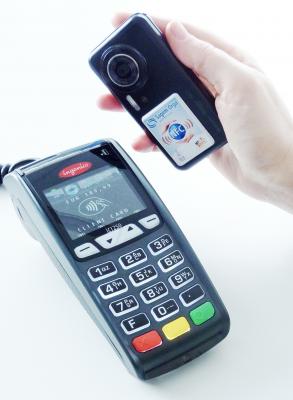
Twinlinx CEO Jacek Kowalski told NFC Times the company plans to ship nearly 4,000 stickers by the end of June for field trials this summer. About 400 of those stickers would be ready in May. He declined to say who would test the sticker, outside of RATP, which is also an investor in the 2006 startup.  

Kowalski said plans call for shipping another 6,000 stickers in September and 10,000 in October.

“We will have exactly the same (NFC) user experience, except that you’ll be able to put the sticker on the phone,” said Kowalski. “It becomes exactly like an NFC phone.”

Equaling the NFC interface and functionality will not be easy, but Kowalski, former CEO and co-founder of NFC chip supplier Inside Contactless, said he has worked out a way to combine NFC and Bluetooth chips in the same sticker and to do a quick pairing of the Bluetooth chip in the sticker with the one in the phone.

This would enable banks or other service providers to give their customers a user interface on the handset screen, tied to their applications in the sticker. They could also deliver the applications and manage them over the air. And they could do it independently from mobile operators.

Smart card chips, including those supporting standard Java Card software supplied by smart card vendor Sagem Orga would offer a secure element for banks and other service providers to store their payment applications  in.

Sagem Orga, also an investor in Twinlinx, said it has a number of customers lined up wanting to test the sticker, which it calls NFC Mobile Wallet, once Twinlinx delivers the goods.

“It’s something they (banks) can have fast on the market, which brings real EMV transactions, not only mag-stripe emulations,” Sébastien Poly, marketing manager for Sagem Orga’s banking line, told NFC Times. “You can do offline transactions with the same security as you can do with EMV dual-interface cards.”

Not So Passive
The direct connection with the handset is an advantage NFC/Bluetooth stickers like MyMax hold over passive contactless stickers, such as Go-Tag stickers marketed by U.S.-based processor First Data and the FlyBuy sticker from French smart card vendor Oberthur Technologies. Passive stickers cannot communicate directly with the phones they might be attached to, although they are much cheaper than the more active stickers with Bluetooth.

Both passive and NFC/Bluetooth stickers require shielding to reduce distortion from metal in the handsets to the radio waves transmitting data to readers. Neither of the sticker types work on 100% of phones. And, of course, phones without Bluetooth chips would not communicate with the Twinlinx sticker.

Compared with contactless microSD cards, which come embedded with tiny radio antennas and secure chips, the Twinlinx stickers support something close to full NFC. They work in reader mode, which would enable users to tap the stickers on RFID tags embedded in posters or other surfaces to receive small amounts of data, such as URLs or SMS short codes. This would open Web browsers on the phones, enabling users to download coupons, videos or other content over the network.

Contactless MicroSDs, at least at present, only work in card-emulation mode–that is, they transmit data only when powered up by the RF field of readers–similar to contactless cards or passive stickers. Twinlinx stickers support card emulation mode, besides reader mode, but do not yet work in NFC’s peer-to-peer mode.

One advantage of passive stickers over either NFC/Bluetooth stickers or contactless microSDs is that passive stickers are market tested. Contactless microSD suppliers, such as DeviceFidelity and Tyfone, as well as Twinlinx and Sagem Orga, will have to prove their products work in field tests this summer.

Slim Down Needed
Unlike the passive stickers and microSDs, MyMax requires its own power source, which comes from a built-in battery. That also adds to the sticker’s bulk, at 2.5 millimeters thickness. By comparison, a standard credit card is about 0.7-mm thick. It also requires six hours to charge the Twinlinx sticker.

Kowalski hopes to slim the sticker down to 2 mm by the end of the year, and to remove a button users need to push to activate the sticker. Visa and MasterCard, however, may want to keep the button as an option, giving consumers an on-off switch for their payment devices.

Kowalski also intends to slim down the price of the stickers from 20 euros (US$26.40) apiece for significant quantities to 15 euros each by the end of the year or early 2011. The goal is a 10-euro price tag next year or later.

“How many people put rubber skins (on their phones), in which they pay 20 to 30 euros? So 10 euros is not expensive,” Kowalski contends.

Twinlinx also plans to shorten the recharging time to two hours. The battery is good for 500 taps in reader mode on a single charge, he said.

Telco Interest and Anxiety
French mobile operator Bouygues Telecom, also a Twinlinx investor, plans to trial the stickers, as well, probably in September. The telco has stated in the past it wants to use the sticker only in reader mode, to  enable subscribers to tap smart posters to download information. At least one other, much larger, European mobile operator is interested in the sticker, said Kowalski.

But that telco will likely insist applications are run on SIM cards it issues. While it will be possible to store applications on the SIM inserted in the phone while using the sticker as a contactless interface–via Bluetooth–transaction times might be too long.

Other telcos will consider the NFC/Bluetooth sticker a threat, especially when it packs an embedded secure chip, because banks could offer mobile payment without sharing revenue with the operators.

Besides the smart card chip supporting standard Java Card software, there will also be versions with a MicroPass chip from Inside Contactless, which banks use for their magnetic-stripe-based PayPass and Visa payWave contactless cards in the U.S.

MasterCard and Visa have not yet certified the sticker for payment, which would require the stickers to work in all PayPass or payWave terminals at an adequate reading range. Since the chips embedded in the stickers are the same as banks use for their payment cards, security should not be an issue during the certification process.

Of course, pilots beginning in mid-2010 followed by full certification and possible rollouts hinges on Twinlinx hitting its new delivery schedules and the stickers working as planned. NT