HEADLINE NEWS

OTI to Supply Contactless and NFC Readers for Gasoline Stations in North America

Israel-based contactless and NFC vendor On Track Innovations announced Monday it had received an order for 30,000 readers for point-of-sale terminals at retail gasoline stations in North America.

Taxis in Major U.S. Cities to Get NFC-Enabled Video Ads

Riders in 5,000 taxicabs in the U.S. would be able to tap on NFC tags on video advertising screens to download apps, brand information, coupons, maps, music and videos, according to technology suppliers that have equipped the taxis for potential advertising campaigns.

Analyst: Banks Have More to Fear from Cloud-Based Technologies Than NFC

Banks have much more to fear from cloud-based mobile payment than from NFC, even if mobile operators control the secure elements that hold the banks’ payment applications.

GSMA Proposes Global Standard for NFC-Enabled Loyalty and Couponing–Using SIM Cards

May 10 2013 (All day)

The GSMA mobile operator trade group is proposing a global standard for how point-of-sale terminals talk to NFC-enabled mobile wallets to enable consumers to redeem coupons and rewards.

Taiwanese Bank Gets Approval for NFC-Enabled Credit Cards; Okay for Other Banks Expected

Taiwanese banking regulators, as expected, have approved the first bank to issue mobile credit cards that could be downloaded over the air to SIM cards.

UK Retailer Marks & Spencer Sees Growing Use of Contactless

Marks & Spencer, one of the UK’s largest retailers, announced today it had rolled out contactless payment to 644 of its UK stores and said 14% of its card transactions under £20 (US$30.97) are contactless.

Identive Reports Growing NFC Business; Blames Flat Sales, Losses, on U.S. Budget Cuts

U.S.-based Identive Group reported growing NFC and smart card reader business, but fell back into the red during for the first quarter, a loss it largely blamed on U.S. federal government budget cuts.

German Bank and Telco Hold Small NFC Trial; Larger Launches Planned in Country This Year

As Germany gears up for NFC, German bank Dortmunder Volksbank along with Telefónica (O2) Germany have launched a small pilot putting a credit application onto SIM cards in Western Germany.

Cashless Technology Company Announces Rollout of Isis SmartTap on Vending Machines

Vending technology company USA Technologies plans to integrate the SmartTap mobile-commerce software into all of the company’s nearly 100,000 NFC-enabled terminals on vending machines nationwide.

Vendor Group: NFC Secure Element Market to Grow by Two-Thirds This Year

Smart card vendor association Eurosmart has substantially increased its estimate for NFC secure element shipments for 2012–by 50% to 150 million units–and forecasts that secure element shipments will grow by another 67% in 2013 to 250 million units.

Gemalto Reveals Some Details of MCX Deal; Vendor Will Earn Fees for Transactions

France-based smart card and security vendor Gemalto will operate the mobile-payment platform for U.S. merchant group MCX, earning a fee for every transaction, in addition to what appears to be a hosting fee it says is worth tens of millions.

Inside Reports NFC Revenue Down Sharply in First Quarter; Some Recovery Expected in Q2

France-based chip supplier Inside Secure today reported a sharp decline in its revenue in the first quarter from its NFC chips, blaming the situation on excess inventories of NFC chips on hand by its main customer BlackBerry.

Visa Europe to Send Out Olympics Phone Next Week in Prep for Games

Jun 18 2012 (All day)

LONDON – Visa Europe will begin sending out its designated Olympics phone, the Samsung Galaxy S III, to executives with European banks, mobile operators and retailers, along with athletes, starting next week, in preparation for the start of the games next month, according to Mary Carol Harris, vice president for mobile at the payment network.

She said that besides London, there will be small NFC mobile-payments projects using the phone in Poland and Italy around the time of the Olympics.

Visa and Samsung, both Olympics sponsors, last month confirmed that the handset maker’s recently released flagship smartphone, the Galaxy S III, would serve as the commemorative Olympics phone. They will use it as part of a trial to demonstrate NFC mobile payment in and around Olympics venues.

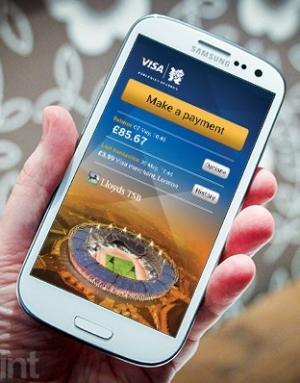
Harris said Visa will be distributing about 1,000 of the high-end Android handsets to the executives and athletes in Europe.

“(The) reason we’re doing this is we really want to influence the decision making of these companies to push this technology out across Europe,” said Harris, who was speaking at the NFC Payments Europe conference in London this week. “For us, this is something that Visa has never done before. We’ve never used the (Olympics) sponsorship in this way to really drive a particular product agenda.”

In response to a question from NFC Times, Harris declined to give details of issuers or mobile operators involved in the projects in Poland and Italy. They are likely to be only small trials involving staffers of banks, merchants and telcos.

She also declined to say which operators and banks plan to commercially launch NFC mobile payment this year with the Galaxy S III, but m-payment players in such countries as Poland, the UK and the Czech Republic–where thousands of contactless point-of-sale terminals are being rolled out–are expected to launch NFC services with the phone, among others, in 2012.

France Telecom-Orange has added the Galaxy S III to its lineup of NFC “Cityzi” phones in France, though the handset still needs a software update over the air before it can be used for secure NFC services.

The Orange branch in the UK, along with issuer Barclaycard–which last year together launched their Quick Tap NFC mobile-payment service using a PayPass prepaid application–is not believed to be ready to launch on the Galaxy S III. In fact, the Quick Tap application is available on few models and not even the predecesor to the latest Samsung flagship phone, the Galaxy S II.

Both Visa and MasterCard have already certified the Galaxy S III to run their respective contactless applications on approved NFC SIM cards.

Two-Year Olympics Phone Project
Harris said Visa approached Samsung with the project two years ago and sent teams to Samsung's headquarters, South Korea, as the Galaxy S III was being finalized to make sure it would work on payWave-enabled point-of-sale terminals worldwide.

Harris said Samsung was receptive to the idea because it wanted to position itself as the “leading smartphone manufacturer for mobile payments moving forward. 

“And also, obviously, the visibility of this new device will have an impact on Samsung’s sales, which also is an objective of their participation,” she said.

For the Olympics phone, mobile operator Telefónica (O2) UK will issue the SIM cards, which will come with a prepaid Visa payWave application preloaded. Lloyds Banking Group will issue the prepaid application, which can be funded only with Visa credit and debit cards. The applet will run on NFC SIMs produced by Germany-based Giesecke & Devrient.

The device will have a special Visa-branded user interface for the Olympics. And there will be an additional application that will enable users to get alerts and real-time information about the games. There will also be loyalty and voucher offers with a “select number of partners,” said Harris. But it’s unlikely users would be able to collect or redeem these rewards points or vouchers with NFC.

McDonald’s restaurants and Coca-Cola, both Olympics sponsors, may be involved in the offers. Both will accept contactless payment from the phones as well as cards. McDonald’s already accepts contactless payment at its 1,200 UK stores. Coca-Cola will accept payWave from vending machines.

High-Value Payments with ‘Passcodes’
Visa has installed 3,000 payWave-enabled point-of-sale terminals in Olympics arenas and other venues that will accept both high-value and low-value contactless payment. This will enable users to make purchases above £20 (US$31.30) by entering a passcode on their handset keypads.

Harris said Visa Europe has mandated that by October all new contactless POS terminals in Europe will have to support high-value payment from EMV-based payWave applications. Consumers would enter a four-digit “passcode” on their NFC phones before the first tap on the terminal or after the terminal asks for the authentication, which would require the user to enter the code and tap again.

UPDATE: Visa Europe's requirement is that by June 1, all new contactless POS terminals had to support high-value payment. By October, acquirers will have to be able to process the transactions. Visa predicts all merchants accepting contactless terminals will be able to take the high-value payments in Europe in about 18 monhts. END UPDATE.

MasterCard is also believed to be requiring new contactless EMV terminals to support high-value PayPass payment. The procedure for high-value NFC payments was originally developed in France, but the international payment schemes have made changes to it.

By the time of the opening ceremonies of the London games, July 27, there will be 140,000 contactless POS terminals in the UK, though only the 3,000 at the Olympics venues will accept high-value payment from the NFC phones, said Harris.

She told NFC Times that Visa is confident enough in the security of having consumers enter their codes on the insecure handset keypads, since even if a hacker were to be able to steal the code with a keystroke-logging virus, he wouldn’t be able to conduct a transaction without the phone. And the payment account data and keys remain on the secure element on the SIM card.

“We’ve isolated the sensitive payment data; only the authorized Visa mobile gateway can access it,” she said. “We come from the assumption that we can’t trust the device. What we have today, we feel it’s robust enough so it’s ready for commercial rollouts.”

Still, Visa, like other international and national payment networks, is careful not to refer to the code that consumers would enter on their handset keypads as a “PIN,” as is used to secure EMV card payments and ATM withdrawals.

Harris said issuer banks in the future could decide to require users to create a passcode that is different than customers’ card PINs.