
U.S. Bank To Test microSD Cards with the iPhone

U.S. Bank believes combining contactless technology with mobile phones might be a way to reinvigorate the contactless-payment experience in the United States.
The Minneapolis-based bank, one of the largest in the U.S., later this year will be among the first of several banks to test contactless microSD cards at the point of sale, putting a Visa payWave application on the tiny flash-memory cards. Among the phones it will line up for the test will be Apple's iPhone, using a special attachment from the supplier of the contactless microSDs, U.S.-based DeviceFidelity.
The U.S. Bank trial, planned for the fourth quarter, will be held among employees and their families and friends in one or more cities.
“Contactless (card) acceptance is still not ubiquitous; there is a challenge there,” Dominic Venturo, chief innovation officer in U.S. Bank's retail payments group, told NFC Times.
He was referring to challenges with both acceptance at the point-of-sale and adoption by consumers. But add mobile phones, and the situation could change, both for consumers and merchants, he said. “All of sudden, you open the door to a lot of other things: coupons or offers and loyalty points and communication of the device. There’s an ecosystem that needs (to be developed) beyond payment in order for the acceptance to move forward in a broad way.”
In addition, contactless-mobile payment could one day complement the bank’s plans for eventually using cell phones for other services, including network-based peer-to-peer funds transfers and delivering coupons over the network, some pinpointed by GPS.
 Venturo declined to disclose many details about the planned microSD trial. But he said among the reasons the bank is interested in trying out the contactless flash-memory card is because customers could insert it into a variety of phones. And it also enables the bank to communicate directly with its customers on their handsets. Besides the iPhone with the special attachment, trial participants will be able to use other phones with microSD card slots.
The microSD trial would follow a pair of contactless-mobile pilots the bank conducted earlier, the first launching around January 2008 using NFC phones, in Spokane, Wash., and then an internal pilot with passive contactless stickers late in that year in Minneapolis, Philadelphia and Atlanta. The bank has also issued some contactless cards and key fobs.
‘Where’s My Phone?’
The NFC-phone trial involved a limited number of employees and students and used phones with a MasterCard PayPass application stored in an embedded chip. The participants liked paying with their phones but were not so excited about the old-style clamshell Nokia NFC phone model, the 6131, they had to use.
“The cardholders, the participants, said, ‘I really have a personal relationship with the phone I bought. Can you figure out a way to have the payments in the device I already like?’ ” said Venturo.
The passive sticker trial also created some issues. Users were concerned about the security of carrying around a phone that was marked as a payment device.
“Consumers didn’t necessarily want a sticker with a bank name or payment logo on their mobile devices,” he said. “It’s sort of like waving around a (payment) card saying, ‘I have this with me.’ ”
A survey by Discover Financial Services of a 700-employee trial of contactless stickers launched last year found the same concerns, with many users saying they would prefer to conceal their payment stickers rather than attaching them to the backs of their phones. But Citigroup recently launched its own passive-contactless sticker, which it intends users to put on their phones.
With microSD cards, the payment feature would be hidden in the phone, but issuers could still present their brands on the handset screen within the phone application, since unlike passive stickers, there would be a connection between the SD card slot and the phone baseband.
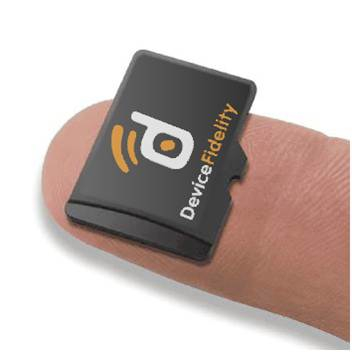 Much still needs to be validated with microSD card technology, however, including whether the tiny antennas embedded in the cards and varying positions of the SD card slots in phones will create problems for consumers when they try to tap to pay. Read ranges for the microSD in general are much smaller than for contactless cards, and the microSDs have to draw power from the phones just to get this limited range, perhaps 1 to 2 centimeters.
In addition, not all phones have microSD card slots, including Apple’s iPhone, although DeviceFidelity's attachment can remedy that. The case, which fits around the iPhone, comes with its own microSD slot and also its own full-size contactless antenna, giving the device the same range as contactless cards–about 4 centimeters–and no extra power draw from the phone for the transaction.
Visa, which plans to help organize more bank trials this year of the microSD packing payWave, is testing the card with its own employees. It has not yet certified the device for its payment application. Several banks will test the cards, mainly in the United States, but also in Europe before the end of the year. Among the trials will be those using the iPhone attachment, said Amitaabh Malhortra, chief operating officer for DeviceFidelity.
Issuing Issues
There is also a question of how banks would issue microSDs. One factor to consider is that consumers could put photos, videos and other content on the flash-memory storage that will come with most cards. They might want another microSD card after they’ve filled up the storage space.
Venturo suggests two likely models: One would be to send the flash-memory cards prepersonalized to customers, as banks do with conventional credit and debit cards. The other is to allow customers to buy the microSDs in electronics or other stores, with a preloaded payment application or one that is blank. A trusted service manager could personalize the preloaded application or send the entire application over the air to a secure element embedded in the cards.
“It could evolve both ways,” he said. “A lot of it is going to depend on the amount of demand and how the ecosystem evolves.”
Many issuers will likely prefer to issue the microSDs through traditional credit and debit card channels, at least at first, said Malhortra. These cards likely would come with less flash memory storage. It would probably not cost extra to personalize them compared with conventional credit and debit cards.
“It’s a much simpler scenario for the average consumer to understand how it works,” he told NFC Times.
Over-the-air downloading of applications would likely come later. That is a feature that DeviceFidelity added later and among other things requires a secure channel between the phone baseband and the microSD card slot.
Threat from Mobile Operators?
One advantage of microSD payment cards for banks over actual NFC phones is that bankers could avoid working directly with mobile operators to introduce contactless-mobile payment.
Banks and mobile operators in the U.S. are not generally talking to each other about NFC-based mobile payment like they are in a number of other countries. And the big U.S. mobile carriers, including Verizon and AT&T, in fact, have been planning to launch their own mobile-payment services or their own scheme, using contactless-mobile and NFC technologies, including possibly microSD cards.
When asked if he considered such an initiative a threat to U.S. Bank’s payment business, Venturo responded like other bankers, as well as Visa, when asked the same question. He does not mention the U.S. telcos by name, instead grouping them with other present or potential competitors.
“We have a ton of competitors of all different sorts and types, and we manage our products, and we continue to grow our business,” Venturo said. “That marketplace will continue to evolve.”
 Facebook
 Twitter
 LinkedIn
HEADLINE NEWS


Syndicate

