
Add-On Needed to Extend Range of microSD Cards in Certain Phones
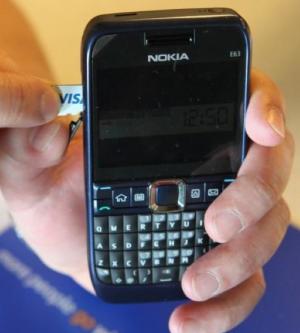
U.S.-based technology company DeviceFidelity will announce a new add-on for mobile phones, which will be necessary to ensure a consistent experience for consumers tapping certain handsets to pay, including the popular Samsung Galaxy S, NFC Times has learned.
The add-on–a sticker containing an extra antenna or coil–is needed to extend the range of the company’s In2Pay microSD cards, which will carry a Visa payWave application. Without the add-on, the read range for a number of phones with point-of-sale terminals would be extremely small, in most cases.
Consumers would be asked to affix the sticker, which DeviceFidelity calls a Range Extender label, to the inside back cover of their phones, giving the devices an increased range of 2 to 4 centimeters, and allowing consumers to tap the back of the phones every time to pay, not the part of the phone where the microSD slot is located. Without the extra antenna, the read range might be only 2 millimeters or less, much too small to meet Visa’s requirements.
Visa last month announced it would certify the first three smartphones for use with the DeviceFidelity microSDs packing payWave, including one of the Galaxy S models, the Vibrant. But the announcement didn’t mention the need for an extra antenna sticker.
As part of that same announcement–which Visa noted was the first time in its history it had approved a mobile-payment product for commercial launch–the card network said it would also certify the current and previous two iPhone models and the Blackberry Bold 9650. Visa had lowered the required read range for the microSDs and other NFC "bridge" technologies to 2 centimeters from 4 centimeters required for conventional contactless cards. It lowered the range for the bridge devices because they generally have smaller antennas.
Four major U.S. banks, including Bank of America, JPMorgan Chase and Wells Fargo, began testing the In2Pay technology last fall. Some observers believe microSD cards will be a key part of the strategy of the banks to enter the mobile-payment market and compete with U.S. mobile carriers planning to launch their own payment brand on NFC phones next year. Banks can issue the microSDs without dealing with telcos.
DeviceFidelity had already announced an add-on to enable its microSDs to work with the iPhone, which does not have its own microSD card slot. The iPhone case or sleeve it developed, called iCaisse, not only has its own slot but a full-sized contactless antenna, so the read range with point-of-sale terminals is not an issue–even with POS terminal readers with weaker-than-average signals.
That is not true for phones with built-in microSD card slots. Even though the In2Pay cards draw extra power from the phone’s battery for the transaction, it still is not enough for a certain number of phones because the embedded contactless antenna on the tiny flash memory cards is so small.
"We have found in extensive worldwide testing that there exists a very wide variation of performance in contactless POS readers," Deepak Jain, president and CEO of DeviceFidelity told NFC Times. "There are also certain microSD slot positions in certain devices where the slot is surrounded by a lot of metal."
Metal distorts or weakens the contactless signal. To compensate for these problems, the company invented the range extender, which amplifies the signal from the POS terminals. It makes the user experience "totally consistent across all type of readers" and allows the consumer to tap more naturally on the back of the phone, whatever the position of the microSD slot, Jain said. This combined with the extra jolt from the phone’s battery gives the microSDs the 2- to 4-centimeter range, he said.
Jain, however, declined to estimate the percentage of phones that would need the extra antenna. "It is a moving target," he said in an e-mail response. "With the speed of new devices hitting the market, we are encountering new devices every week."
But attaching the stickers with the extra antenna to the back covers of phones is one more step consumers must take to prepare their phones for contactless payment.
DeviceFidelity and Visa appear concerned about this because the tech company is even planning to offer such options as replacement phone battery covers with "preapplied Range Extenders," and Range Extenders built into the handset battery covers for certain models, such as those telcos could order from phone makers. These options are in addition to self-adhesive labels that Jain contends are "easy for the consumer to attach."
He contends that even with the extra antenna needed to extend the range, microSDs are still "extremely superior" to SIMs or microSD cards connected to flexible antennas that wrap around batteries, being introduced by banks in Turkey and a few other places. MicroSDs with embedded antennas have "no moving parts or fragile flexible connectors."
Visa did not respond to questions on Friday about whether it expects the consumers to be able to attach the additional antenna sticker without difficulty, and whether the extra coil would create any challenges for certification of phones.
 Facebook
 Twitter
 LinkedIn
HEADLINE NEWS


Syndicate

